
Sodium butoxide and sodium tert-butoxide can give different products from the same substrate because changing the alkoxide structure changes the balance between nucleophilic attack and proton removal. Sodium n-butoxide is generally the better starting candidate when the butoxy group must become part of the product. Sodium tert-butoxide is often more suitable when steric hindrance should suppress substitution and favor a base-driven transformation.
That distinction is a screening rule, not a guarantee of selectivity. Both reagents can act as bases and nucleophiles, and their behavior depends on the substrate, solvent, temperature, and physical form. For a technical evaluation, the useful question is whether the change improves the desired pathway without introducing unacceptable impurities or making the process harder to control.
Confirm which “sodium butoxide” the specification describes
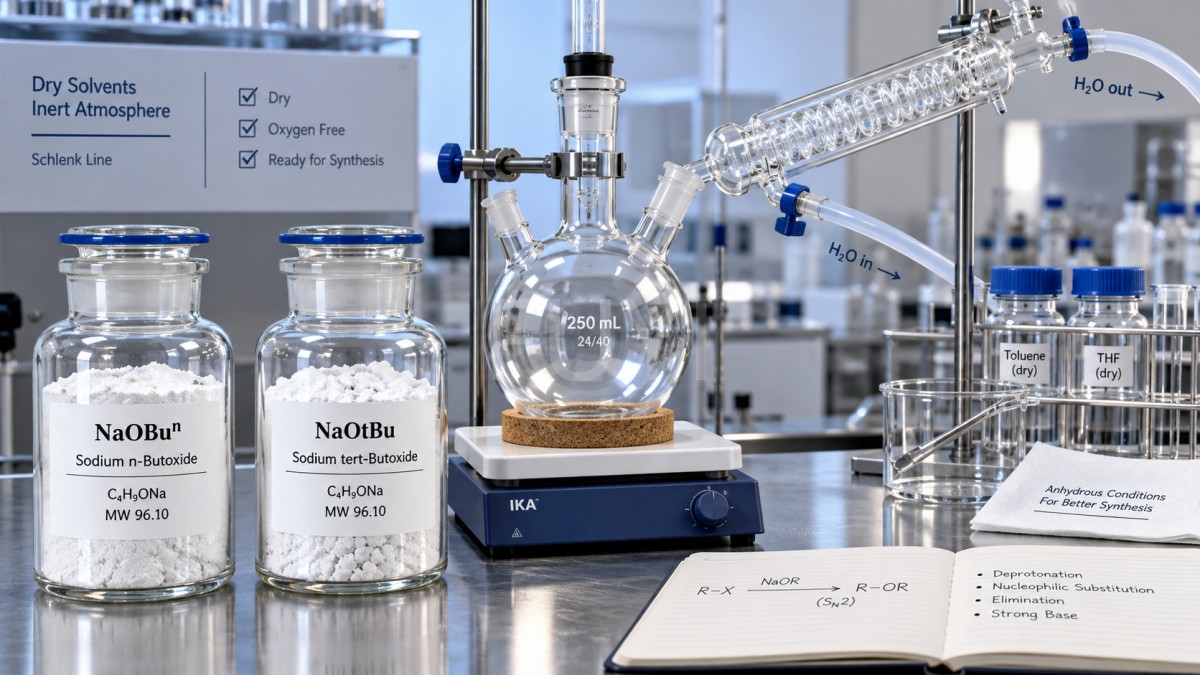
The name Sodium Butoxide should be checked against the structural identity on the specification and safety documentation. In this comparison, it means sodium n-butoxide, CH3CH2CH2CH2ONa, derived from straight-chain n-butanol. Sodium tert-butoxide, (CH3)3CONa, is derived from tert-butanol. Both have the molecular formula C4H9NaO, so the formula alone cannot distinguish them.
The difference sits around the oxygen-bearing carbon. In n-butoxide, that carbon is attached to one carbon group; in tert-butoxide, it is attached to three. The greater crowding in tert-butoxide makes its oxygen less accessible for attack at an electrophilic carbon. A proton can remain accessible even when that carbon is difficult to approach, which helps explain why tert-butoxide often promotes elimination over substitution.
Confirm the isomer, active concentration, and any carrier solvent before comparing prices or calculating charge quantities. A powder and an alcoholic solution bearing similar names may introduce substantially different amounts of alkoxide, alcohol, and water into the reaction.
Choose around the bond-forming step and competing pathways
For a Williamson ether synthesis intended to introduce an n-butoxy group, sodium n-butoxide has a direct structural role: its oxygen attacks a suitable electrophile and the n-butyl group remains in the product. Replacing it with sodium tert-butoxide changes the potential ether product as well as the reaction rate and selectivity. The two reagents are therefore not interchangeable merely because both provide an alkoxide anion.
With an unhindered primary electrophile, n-butoxide can support nucleophilic substitution effectively. As the electrophilic center becomes more crowded, substitution becomes less favorable and elimination becomes more competitive. Secondary substrates deserve particular attention because either pathway may contribute. Tertiary alkyl centers do not support ordinary SN2 substitution, regardless of which alkoxide is selected.
Sodium tert-butoxide is a useful candidate when elimination is the intended transformation. Its steric bulk can favor removal of a more accessible beta hydrogen, sometimes increasing the proportion of the less substituted alkene. However, substrate conformation, leaving-group geometry, and the availability of suitable beta hydrogens can override that tendency. In cyclic substrates, stereochemical requirements may constrain which alkene can form.
Calling tert-butoxide “non-nucleophilic” is too absolute. It is a hindered nucleophile and can still react with sufficiently accessible electrophiles. Likewise, n-butoxide should not be treated as a substitution-only reagent: it can promote elimination when the substrate and conditions favor that route.
For deprotonation, tert-butoxide is generally the stronger base when the comparison is made in the same solvent, consistent with the lower acidity of tert-butanol relative to n-butanol. That does not make it adequate for every carbon-acid substrate. Deprotonation feasibility depends on the relevant acid–base equilibrium, and product trapping may be needed to drive the desired reaction. Stronger basicity can also increase unwanted epimerization, decomposition, or elimination.
Acyl substitution adds another selection constraint. Where an alkoxide participates in ester exchange, its alkyl group can determine the ester produced. Introducing n-butoxide into a process designed to retain a different ester group can create an impurity pathway. The linked Sodium Methoxide is relevant when methoxy incorporation or methyl-ester chemistry is required, but it requires a separate compatibility assessment. Selecting an alkoxide solely by base strength can overlook this product-identity issue.
Solvent and physical form can alter the comparison
The solvent influences ion pairing, aggregation, solubility, and how much alkoxide is available to react. A result obtained with a clear solution cannot automatically be transferred to a slurry, even at the same nominal molar charge. In a heterogeneous mixture, dissolution and mixing may affect conversion, local concentrations, and batch reproducibility.
An alcohol carrier also participates chemically. Adding sodium tert-butoxide to n-butanol allows proton exchange that generates n-butoxide and tert-butanol; the resulting composition depends on the equilibrium and mixture conditions. More generally, a protic solvent can change the alkoxide population and its effective reactivity. A reagent selected for steric bulk may therefore behave differently after entering the reaction medium.
Changing to an aprotic solvent does not remove all uncertainty. Solvent coordination to sodium and the extent of ion pairing can change reaction rates and selectivity. The practical comparison should use the intended production solvent, including the alcohol introduced with a commercial solution. Otherwise, an apparent reagent effect may actually be a solvent-composition effect.
Physical form matters most when it affects dosing and heat release. A solid requires a controlled charging or dissolution procedure, while a solution introduces a fixed solvent burden. Particle characteristics can influence handling and dissolution, but appearance alone provides little evidence of chemical suitability. Establish whether the selected grade produces a solution or suspension under the actual charging conditions.
Both alkoxides react with water, forming the corresponding alcohol and sodium hydroxide. Carbon dioxide exposure can introduce carbonate-containing impurities. These changes reduce the intended alkoxide content and may introduce competing chemistry: hydroxide can encourage hydrolysis, while altered solids content can affect mixing. Dry equipment, controlled exposure, and suitable storage protect both selectivity and dosing accuracy.
Evaluate active composition and process performance together
A total-alkali result is insufficient on its own to establish how much usable alkoxide a batch contains. Depending on the analytical method and reporting convention, hydroxide or other basic species may contribute to the measured value. Technical qualification should distinguish alkoxide content from free alkali and carbonate, and establish how residual alcohol, solvent, and water are measured.
Charge calculations should follow the defined active-content method rather than a purity figure whose basis is unclear. This is especially relevant when comparing suppliers or switching between solid and solution grades. Equal gross masses, or equal total-alkali values, do not necessarily deliver equal amounts of the intended reactive species.
A useful comparative evaluation focuses on a few outcomes tied directly to the proposed synthesis:
- Desired reaction: measure conversion and product selectivity at comparable active molar charges, accounting for carrier-solvent differences.
- Competing chemistry: follow substitution products, alkene isomers, hydrolysis products, and stereochemical changes where they affect quality.
- Process behavior: assess dissolution, mixing, temperature response during addition, and the effect of any required reaction hold.
- Isolation: check whether the different alcohol and salt profile changes workup, product recovery, or residual-impurity removal.
The preferred reagent should remain acceptable across the operating range the plant can reliably maintain. A favorable result under one narrowly controlled condition may be difficult to reproduce if modest variation in water content, dosing rate, or mixing shifts selectivity. Scale-up also requires assessment of addition and quench heat release; laboratory conversion alone does not establish a manageable production process.
For a route that needs an n-butoxy bond, sodium n-butoxide is the logical starting point. For a route that needs a hindered base to limit substitution or encourage elimination, sodium tert-butoxide deserves evaluation first. The final selection rests on the impurity profile and process behavior in the intended reaction medium, with reagent identity and active composition controlled closely enough to reproduce that result.
Leave A Message
If you are interested in our products and want to know more details, please leave a message here, we will reply you as soon as we can.