
What causes liquid sodium methoxide to lose strength during storage?
Has your stored Sodium Methoxide Liquid started delivering inconsistent reaction results? Moisture and carbon dioxide are the main suspects: both can consume active sodium methoxide after entering a container. Poor sealing, repeated opening, contaminated transfer equipment, and unsuitable temperatures can also change solution quality or concentration.
But “loss of strength” needs a careful definition. A lower active methoxide content, a changed methanol concentration, and poor dosing from a partly blocked line can produce similar symptoms. Adding more material before identifying the cause may make the next batch harder to control.
Moisture changes the chemistry, not just the concentration
Commercial liquid sodium methoxide is commonly supplied as a solution in methanol. When water enters, it reacts with sodium methoxide to form methanol and sodium hydroxide:
CH3ONa + H2O → CH3OH + NaOH
That distinction matters on the plant floor. The solution may still show substantial alkalinity even though some methoxide has been converted to hydroxide. In a moisture-sensitive synthesis, or an ester-processing operation where water promotes hydrolysis and soap formation, those two materials are not interchangeable.
Water does not have to arrive as an obvious spill. A hose washed with water and inadequately dried, a damp sampling tool, or humid air drawn into a drum during withdrawal can introduce it. If a fresh container performs normally but the same container becomes unreliable after several withdrawals, inspect the handling path before blaming the original production batch.
Air exposure brings carbon dioxide as well as humidity
Carbon dioxide reacts with sodium methoxide and can form carbonate-related species. Depending on moisture content and solution conditions, contamination may eventually appear as haze, deposits, or precipitated salts. The chemistry is more complicated than simply saying that every exposure immediately produces sodium carbonate.
Repeated opening is particularly troublesome because each withdrawal replaces some liquid volume with incoming gas. A cap that looks secure may still have a damaged gasket, while a transfer connection can admit air without leaking enough liquid to attract attention.
Check the entire system: closure, seals, vent arrangement, pump connections, and sampling point. For approved installations, a properly designed dry inert-gas system can limit air ingress. It must follow the supplier’s instructions and the container’s pressure limits; improvising a nitrogen connection on a drum is not an acceptable substitute.
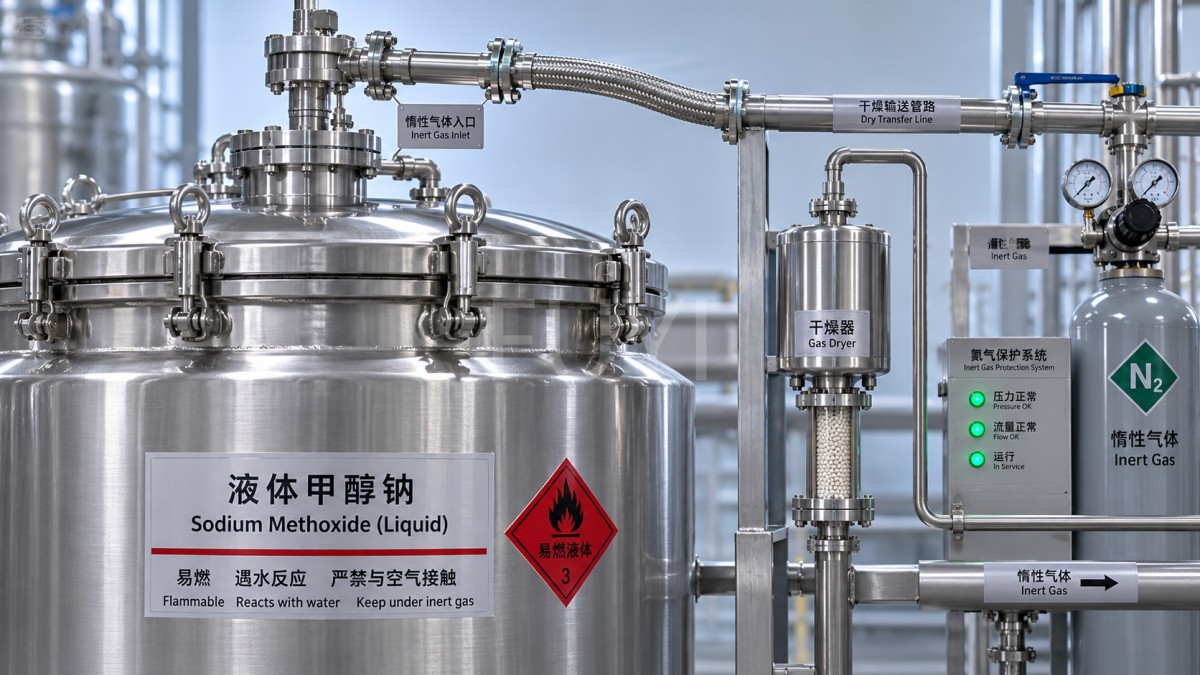
Temperature can change apparent strength in either direction
Warm storage can increase methanol evaporation where containment is inadequate. Solvent loss may raise the measured sodium methoxide concentration rather than lower it. The material can therefore become less predictable without becoming “weaker” in the straightforward sense.
Cooling can reduce solubility for some grades and compositions, potentially causing crystallization or separation. A sample drawn from the clear upper layer may then fail to represent the container as a whole. Settled material can also interfere with withdrawal and make a volumetric dose inconsistent.
Use the storage range specified for the actual product concentration and packaging. There is no universal temperature setting suitable for every sodium methoxide solution. If solids appear after cold storage, quarantine the container and ask the supplier whether controlled conditioning is appropriate. Do not apply direct heat or assume every deposit is harmless crystallization.
Separate a quality problem from a dosing problem
Before adjusting a recipe, compare the current material with its certificate of analysis and your receiving results. Record the lot, opening date, storage conditions, and transfer history. A useful investigation focuses on a few checks:
- Confirm whether the laboratory result represents active sodium methoxide, total alkalinity, or another reported basis.
- Use the supplier-approved analytical method; a general acid-base titration may not distinguish methoxide from hydroxide and other alkaline species.
- Check water with a method validated for the strongly alkaline methanol matrix, rather than assuming a routine moisture test is suitable.
- Inspect filters, pump delivery, and flow measurement if consumption records disagree with actual reactor performance.
Sampling itself deserves attention. An open beaker exposed to humid air can change the sample before testing. Use a closed or otherwise validated sampling procedure with dry, compatible equipment. Where separation is suspected, follow an approved representative-sampling procedure rather than shaking or stirring the container informally.
Appearance is a warning signal, not a release test. Clear liquid can still contain too much water or too little active methoxide. Conversely, visible solids need identification before anyone decides whether to recondition or reject the material.
The most useful storage improvements happen at the transfer point
Keeping containers closed helps, but dedicated dry transfer equipment often deserves equal attention. Shared hoses, poorly dried pumps, and residual cleaning liquids can defeat otherwise good warehouse conditions. Avoid returning unused process material to the original container, where it can contaminate the remaining stock.
Match container size to consumption where practical. A large drum opened repeatedly over a long period may expose the remaining material to more handling than a smaller package used promptly. That trade-off should be evaluated against packaging cost, safe transfer arrangements, and the supplier’s guidance for opened containers—not an invented universal shelf life.
Sodium methoxide solution is strongly alkaline, and its methanol solvent is toxic and flammable. Storage and sampling require the product safety data sheet, compatible equipment, ignition control, ventilation, and appropriate protective measures. Suspect material should not be “restored” by adding chemicals or evaporating solvent on site.
Keep specifications specific to the chemical and the lot
For a producer and trader such as Zhenfeng Chemical, whose activities include alcohol-series products, sodium products, and organic chemicals, useful technical support means clarifying the supplied concentration, assay method, packaging compatibility, and opened-container handling. Experience with concentrated or crystalline sodium products does not make one storage procedure suitable for every grade.
The same discipline applies to adjacent pharmaceutical-intermediate materials such as Diemethyl oxalate, listed under CAS 553-90-2 with purity ≥99% and a melting point of 54 °C. That melting point makes physical state temperature-dependent, so a description of clear liquid appearance should not be treated as an unconditional room-temperature specification. Nor should packaging specified for that product be assumed suitable for sodium methoxide.
If stored Sodium Methoxide Liquid starts behaving differently, hold the affected lot, obtain a representative sample, and compare active content with the original specification. Investigate water entry, air exposure, solvent loss, and delivery accuracy separately. Increase the dose only after the material’s composition and suitability have been established.
Leave A Message
If you are interested in our products and want to know more details, please leave a message here, we will reply you as soon as we can.