
Reagent-grade formic acid is worth the extra cost when its specified impurity limits, batch documentation, and consistency protect a result that would be expensive to repeat or difficult to defend. For routine work with generous acceptance limits, a less expensive grade may be sufficient. The decision depends on what the acid contributes to the procedure and which contaminants could interfere.
When comparing listings for formic acid reagent grade, start with the application and the certificate of analysis. A higher assay alone does not establish suitability. Two products with similar formic acid content can have different limits for metals, chloride, sulfate, or nonvolatile residue—and those differences may matter more than the headline purity.
Pay for the specification your method actually needs
“Reagent grade” describes a quality category, but the label does not provide a complete specification. Suppliers may offer different limits or refer to different published specifications. Compare the properties they guarantee rather than assuming every bottle bearing the same grade name is interchangeable.
Assay describes the amount of formic acid present. Concentration also affects how much water enters a reaction or solution. Neither tells you the full impurity profile. Even an acid assay determined by titration may not distinguish formic acid from every other substance that contributes acidity.
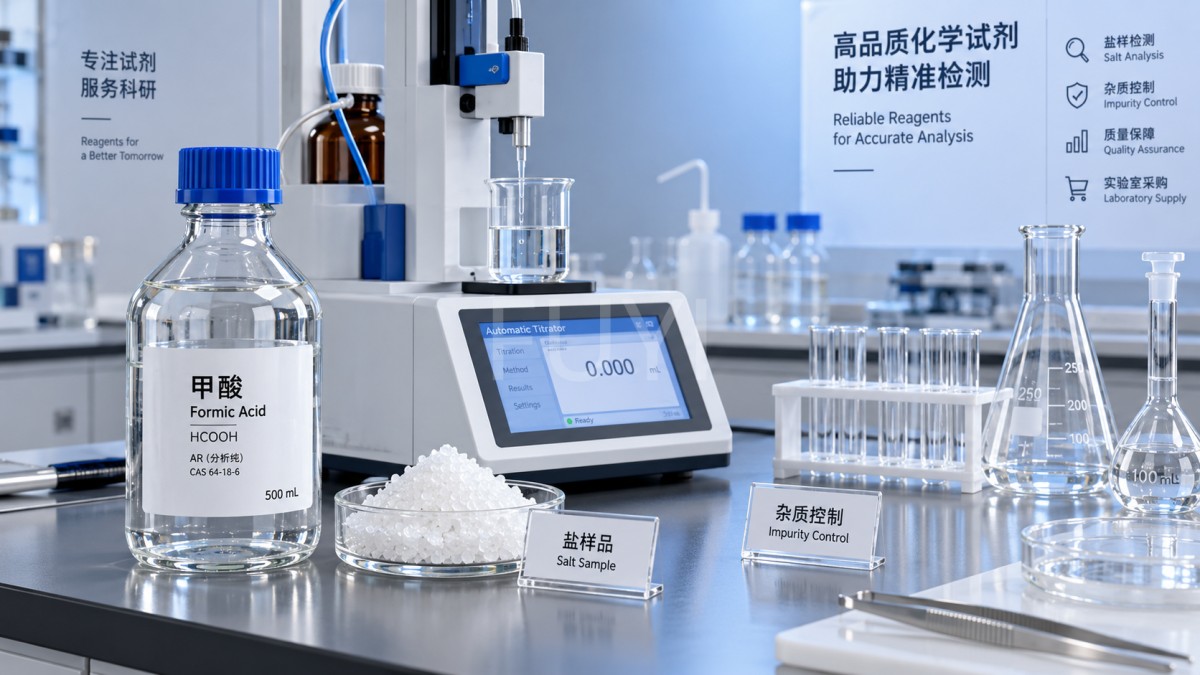
For salt testing, the relevant impurity depends on the measurement. Sodium contamination matters when measuring low concentrations of sodium. Chloride or sulfate contamination matters when those ions are being determined. Nonvolatile residue can affect procedures involving evaporation or residue measurement. The useful question is whether the reagent introduces enough background to compromise the method’s acceptance criteria.
Also establish whether formic acid is appropriate for the procedure itself. It is a weak organic acid with reducing behavior under some conditions. A higher grade cannot correct an unsuitable digestion chemistry, unwanted reaction, or incompatible sample preparation step.
Where the premium usually earns its place
Low-level analysis is a strong reason to pay more. When the analyte concentration is small, contamination from sample preparation reagents can become a meaningful part of the measured signal. An acid with suitable impurity limits can help keep reagent blanks acceptable and reduce uncertainty about whether a result comes from the sample or the preparation process.
The specific limits still matter. General reagent-grade material may be inadequate for demanding trace-metal work. If metal contamination controls the result, a grade designed and documented for trace analysis may be the appropriate purchase. Paying for a general laboratory label without the required metal limits can leave the original problem unresolved.
Established methods can justify the premium through consistency. If a procedure specifies a particular grade or impurity profile, changing to a cheaper product may require laboratory evaluation, documentation, and approval. Those activities consume time even when the substitute ultimately performs well. Keeping the established material can be economical when the reagent expense is small relative to the cost of changing the method.
Sensitive synthesis can also benefit. In preparing formate salts or using formic acid in organic synthesis, water content and contaminants may affect reaction control, isolation, or final product quality. The premium makes sense when tighter specifications address a known process sensitivity. It adds less value when the process tolerates the impurities and subsequent purification removes them adequately.
Chromatography requires a separate judgment. Formic acid used as a mobile-phase additive may need specifications for chromatographic background or mass-spectrometry suitability. A general reagent grade does not automatically meet those requirements. Match the grade to the detector and method rather than treating laboratory grades as a single quality ladder.
When a lower-cost grade can be enough
A less expensive grade can be reasonable for preliminary synthesis trials, noncritical acidification, or other procedures where the relevant impurities remain comfortably within acceptable limits. This choice is strongest when the laboratory has demonstrated suitability using representative material and the supplier provides a stable specification.
Consider a formate salt preparation intended for further purification. If the process tolerates the acid’s water content and the impurity profile does not threaten the final specification, an industrial or technical grade may be adequate. The same material may be unsuitable when the salt is intended for a sensitive analytical application. The final use changes the purchasing decision.
A related synthesis raw material illustrates why specifications should remain application-specific: Ethyl Chloroacetate is offered at a purity of ≥99% for organic synthesis applications. That figure describes a different chemical and purchasing requirement; it cannot establish the suitability of formic acid for analytical work. Each reagent needs acceptance criteria tied to its role.
A cheaper grade should therefore be a deliberate substitution with defined limits. An acceptable appearance, a familiar supplier, or a satisfactory result from one batch provides less assurance than a controlled specification supported by suitable checks.
Compare the cost per usable result
The bottle price is only one part of laboratory cost. A useful comparison includes reagent consumption, preparation time, incoming checks, discarded solutions, repeat testing, and disposal. Add the effort needed to qualify a new grade if the change affects an established procedure.
Compare equivalent concentrations and usable quantities. A lower-priced aqueous product may supply less formic acid per unit purchased and introduce more water. That can be acceptable for solution preparation but problematic for a water-sensitive reaction. Freight, packaging, and handling requirements can further change the delivered cost.
Use a simple decision rule: the premium is justified when the expected cost it avoids exceeds the additional reagent expense. If both grades consistently meet the method’s requirements, the higher-priced option may offer little operational benefit. If the cheaper grade causes unacceptable blanks or requires repeated investigation, its purchase price understates its cost.
Pack size deserves the same scrutiny. Bulk packaging lowers unit cost only when the contents can be used appropriately within the laboratory’s established storage and use period. Smaller bottles can reduce repeated opening, dispensing contamination, and leftover stock. Packaging should suit consumption as well as price.
What to request before placing the order
Build the comparison around the laboratory’s requirements, then ask each supplier for equivalent information. This makes quotations easier to assess and exposes differences hidden behind similar grade names.
- Concentration and assay: Specify the required range and how concentration is expressed. Include water requirements where the process is sensitive to moisture.
- Relevant impurity limits: Identify the metals, ions, or residue that could interfere with the application. Avoid paying for unrelated limits while leaving a critical impurity unspecified.
- Batch documentation: Request a lot-specific certificate of analysis and distinguish measured results from entries reported only as passing a limit.
- Method compatibility: Record any analytical-grade, trace-analysis, or chromatography requirements already established by the procedure.
- Packaging and supply continuity: Match container size to consumption and ask how changes to specifications or manufacturing sources are communicated.
A safety data sheet supports safe handling; it does not replace the quality information needed to compare grades. Likewise, a typical specification describes the product offering, while a lot-specific certificate connects quality information to the material delivered. Both are useful, but they answer different questions.
Before switching suppliers or grades, evaluate representative material with the checks that matter: an acceptable reagent blank, suitable recovery or precision where applicable, and satisfactory process performance. Keep the evaluation proportional to the consequences of failure.
The most useful purchasing requirement is a short, application-based specification. State what the acid must do, which impurities must be controlled, and what documentation must accompany it. That gives a clear basis for paying more when quality protects the work—and choosing a lower-cost option when it meets the same practical requirements.
Leave A Message
If you are interested in our products and want to know more details, please leave a message here, we will reply you as soon as we can.