
No—the sodium butoxide molecular formula, C4H9NaO, cannot distinguish its isomers. It tells you how many carbon, hydrogen, sodium, and oxygen atoms are present, but it does not show how those atoms are connected. The n-, sec-, iso-, and tert-butoxide forms all share this composition, despite having different structures and potentially different behavior in a reaction.
If a product listing or research paper gives only “sodium butoxide” and C4H9NaO, the identity is incomplete. To establish which form is intended, look for the full chemical name and a structural formula. Analytical data can then support that identification. Matching the formula or molecular weight alone is insufficient.
What C4H9NaO tells you—and what it leaves out
Sodium butoxides are alkoxide salts derived from butyl alcohols. When the hydrogen of an alcohol’s hydroxyl group is replaced by sodium, the resulting salt contains a negatively charged alkoxide group and a sodium counterion. The carbon framework remains the feature that distinguishes the different forms.
The formula records four carbon atoms, nine hydrogen atoms, one sodium atom, and one oxygen atom per formula unit. For an ionic material, “formula unit” is more precise than imagining a separate, isolated molecule. Sodium alkoxides can form associated structures in solids and solutions, but their standard composition is still written as C4H9NaO.
What this notation leaves out is the arrangement of the carbon chain and the carbon atom bonded to oxygen. Those details determine whether the material is the normal, secondary, branched primary, or tertiary form. All four also have the same formula weight, approximately 96.10 g/mol, so that number cannot resolve the ambiguity.
The four structures behind the same formula
The easiest way to see the difference is to compare the alkoxide anions. In the table below, O− represents the negatively charged oxygen; each anion is paired with Na+. These condensed structures show connectivity without implying that the salt exists as a simple, isolated sodium–oxygen molecule.
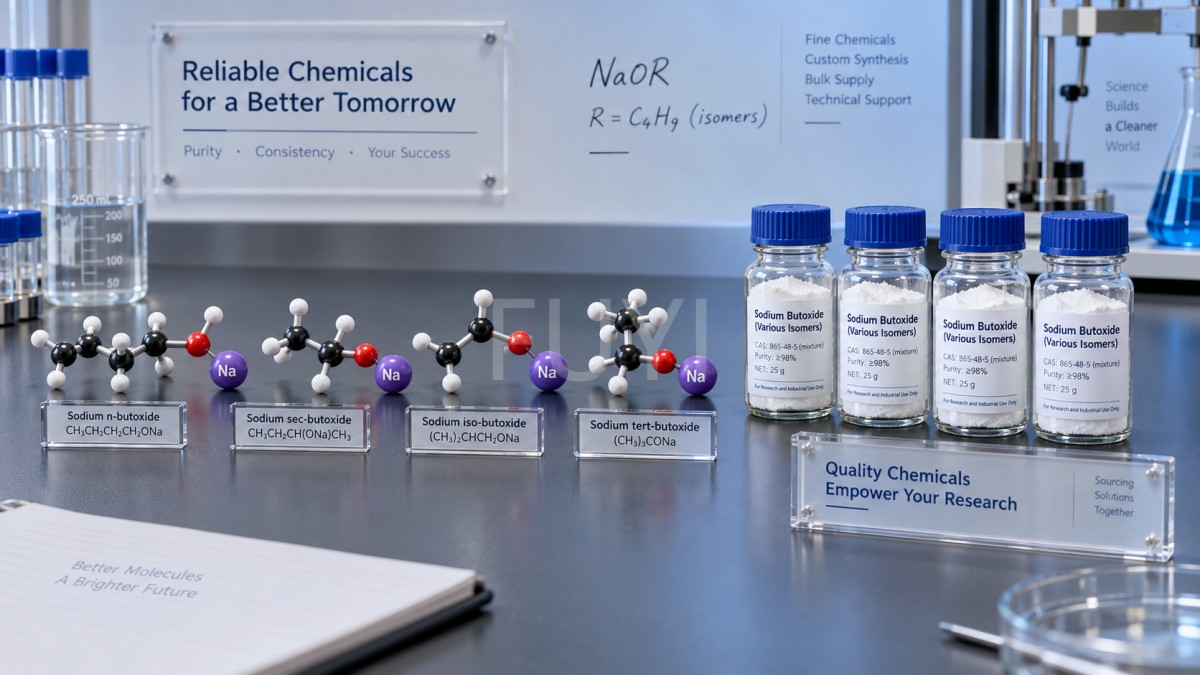
The n- and iso-forms both have oxygen attached to a primary carbon, but their carbon skeletons differ. The sec- and tert-forms place oxygen at more substituted carbons. These are constitutional isomers: their atoms are connected differently.
The sec-form has an additional distinction. Its oxygen-bearing carbon is a stereogenic center, so it can occur in different enantiomeric forms. Neither the molecular formula nor an ordinary connectivity drawing specifies that stereochemistry. If a process depends on it, the identity description must include the relevant stereochemical information.
Why the structural difference matters in synthesis
Sharing a formula does not make these salts interchangeable. Their alkoxide groups can act as bases and nucleophiles, and the surrounding carbon groups affect how readily the oxygen approaches a reaction site.
The tert-form has greater crowding around oxygen than the primary forms. This can make it useful when a reaction requires a strong base while limiting certain competing nucleophilic substitutions. With suitable substrates, it can also favor elimination. However, describing it as completely “non-nucleophilic” would be misleading: its behavior still depends on the substrate, solvent, temperature, and other reaction conditions.
The less hindered primary forms can be more accessible for reactions in which the alkoxide attacks an electrophilic carbon. If the butoxy group is intended to become part of the product, choosing the wrong isomer can introduce a different group and produce a different compound.
Solvent choice also matters. In an alcohol-containing medium, exchange between an alkoxide and the solvent alcohol can affect which alkoxide species are present. Sodium coordination and aggregation can influence behavior as well. A reagent’s name establishes its intended identity, but successful substitution in a process requires attention to the complete reaction conditions.
For example, replacing a specified tert-form with n-butoxide simply because both labels show C4H9NaO can change the balance between substitution, elimination, and deprotonation. Such a replacement needs chemical justification; a matching formula provides none.
Which evidence actually identifies the isomer?
A full chemical name paired with an unambiguous structure is the best starting point. “Sodium butan-1-olate” identifies the n-form, while “sodium 2-methylpropan-1-olate” identifies the iso-form. The prefixes in common names carry essential structural information and should not be dropped when comparing materials.
A CAS registry number is useful for matching a product to an identity record, but it should agree with the written name and structure. A listing that combines conflicting identifiers leaves the identity unresolved, even when the molecular formula is correct.
For analytical confirmation, proton and carbon NMR can distinguish the carbon frameworks through their signal patterns. A straight chain, a branched chain with an oxygen-bearing CH2 group, and a tert-butyl group produce different structural signatures. Interpretation should account for the solvent, sample preparation, and any residual alcohol.
Direct NMR analysis of alkoxide salts can be complicated by solubility and moisture sensitivity. Another approach is controlled conversion to the corresponding alcohol, followed by analysis of that alcohol. This preserves the carbon framework, although residual alcohol already present in the material must be considered when interpreting the result.
Elemental analysis can support the overall composition, but cannot by itself distinguish these isomers. Likewise, molecular mass alone is unhelpful because the forms share the same formula weight. Mass-spectral fragmentation may provide additional clues, but requires an appropriate method and reference comparison. White color, powder form, or granule size does not establish chemical identity.
Read product specifications separately from identity
A specification can describe a high-quality material without proving that it is the isomer required for a particular reaction. Identity, assay, and physical form answer different questions.
For instance, the listing for Sodium Tert-Butoxide specifies a molecular weight of 96.10, total alkali of at least 98.5%, and free alkali of no more than 1.0%, with white powder or granule forms. The full name identifies the intended isomer. The alkali limits describe separate quality characteristics; they do not distinguish its carbon structure from the other butoxides.
Total alkali is an alkalinity measurement whose meaning depends on the assay method and reporting basis. It should not automatically be read as the percentage of the named alkoxide. Free alkali generally addresses uncombined alkaline material, such as sodium hydroxide, according to the specified method. Neither measurement replaces structural identification.
Moisture exposure creates another distinction between identity and condition. Water reacts with sodium alkoxides to form the corresponding alcohol and sodium hydroxide. A container may therefore retain the correct product label while its contents no longer meet the intended composition. Packaging integrity, storage conditions, and suitable batch measurements matter when assessing material for use.
When comparing a paper, safety data sheet, and supplier specification, start by matching the full name and structure. Then establish whether the material is a solid or a solution, what the stated assay measures, and whether the solvent and impurity profile suit the process. If the description stops at “sodium butoxide, C4H9NaO,” the next information needed is the structural identity—not another repetition of the formula.
Leave A Message
If you are interested in our products and want to know more details, please leave a message here, we will reply you as soon as we can.