
A freight quotation can look competitive until the carrier confirms that the shipment requires dangerous goods handling. The revised bill may include a hazardous cargo surcharge, documentation fees, special terminal handling, and additional inland transport costs. For a chemical buyer, these charges can change the supplier ranking even when the product price remains unchanged.
Dangerous goods surcharges increase chemical logistics costs through both direct fees and indirect restrictions on packaging, routing, and shipment size. The most reliable comparison is therefore total delivered cost per unit of usable product, not the base freight rate. Before comparing offers, establish the transport classification and ask each supplier or forwarder to quote the same shipment scope.
Confirm the cargo classification before comparing freight
Neither “salt” nor “sodium-based product” is a transport classification. Products within these commercial categories can have very different hazards, and some may not be regulated as dangerous goods for transport. Alcohol-series materials and other organic chemicals also require product-specific assessment rather than assumptions based on their family name.
Start with the current safety data sheet for the exact grade, concentration, and physical form being purchased. Review the transport information, including any applicable UN number, proper shipping name, hazard class, subsidiary risk, and packing group. Confirm which transport mode the information covers: road, sea, and air requirements are not interchangeable.
The safety data sheet is a starting point, not a substitute for shipment verification. A qualified dangerous goods specialist should resolve incomplete or conflicting information before booking. Carrier acceptance must then be checked for the actual packaging, quantity, route, and destination. A technically compliant shipment may still fall outside a carrier’s operating policy.
Separate the surcharge from the costs it triggers
A line labelled “DG surcharge” rarely describes the full financial effect. Some charges appear on the freight invoice; others are embedded in packaging, warehouse, or delivery quotations. Separating them prevents a low surcharge from masking an expensive overall arrangement.
These fees do not necessarily apply to every shipment. The procurement task is to establish which ones apply and who pays them. A surcharge included at origin may have no relationship to destination handling, while a port-to-port quotation can leave the most difficult delivery leg unpriced.
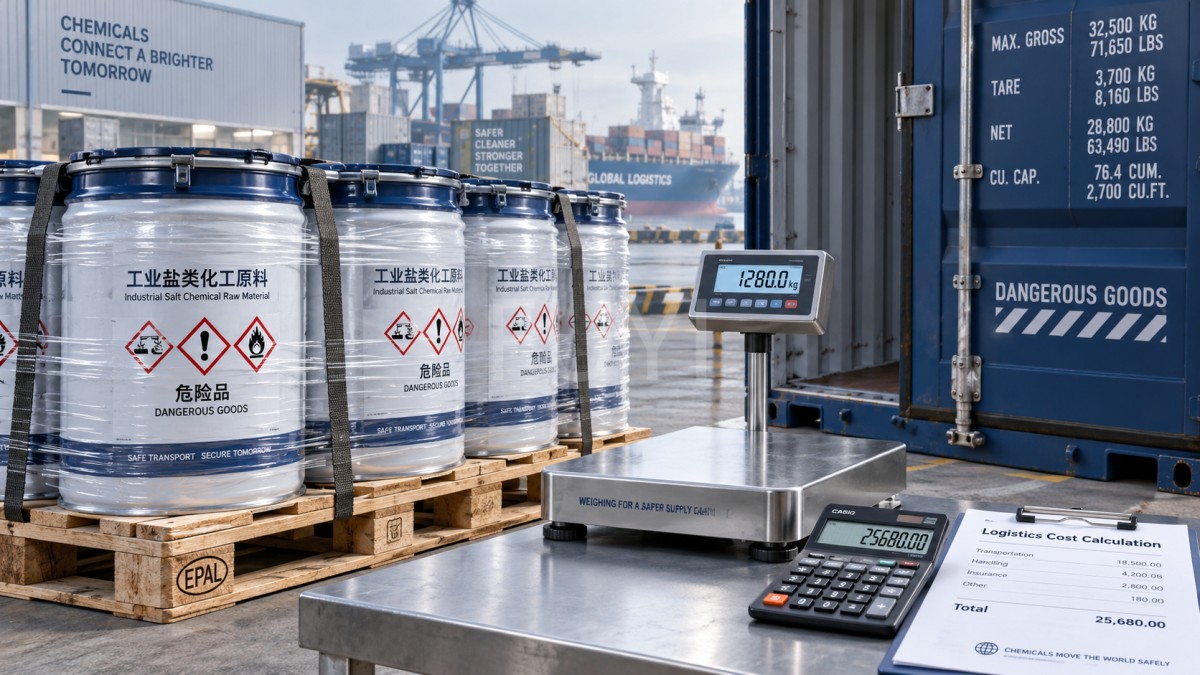
Build a delivered-cost comparison that exposes exclusions
Use one cost worksheet for all supplier offers. Keep the product value separate from base freight, dangerous goods fees, packaging, inland transport, terminal charges, insurance, and applicable duties or taxes. Record the agreed Incoterm and named place alongside each offer so that different responsibility boundaries are visible.
Delivered cost per usable kilogram = total buyer-paid acquisition and logistics cost ÷ usable kilograms received.
For logistics-only comparisons, remove the product value and compare transport-related cost per delivered kilogram. Use net product weight rather than gross shipment weight as the denominator, while retaining gross weight and package dimensions for freight calculations. Freight may be rated on weight, volume, or equipment capacity, depending on the service.
Keep uncertain charges outside the confirmed total rather than silently treating them as zero. Show storage exposure, possible document amendment fees, and unresolved destination charges separately. This distinguishes a genuinely cheaper offer from one that simply leaves more costs unquoted.
Quote validity also matters. Dangerous goods acceptance, freight availability, and surcharge terms can change before dispatch. Ask whether the quoted rate remains applicable if the sailing, shipment quantity, or packaging changes, and obtain revised confirmation before committing to a different arrangement.
Packaging decisions can outweigh the advertised freight rate
The product specification must be precise enough for the logistics provider to assess the shipment. For example, Aniline is listed with CAS number 62-53-3, a purity of at least 98%, and a 200 kg galvanized iron drum option, alongside customer-required specifications. Those details help define a quotation request, but they do not by themselves establish transport compliance.
Before pricing that drum option, confirm the exact grade’s transport classification, packaging compatibility, closure requirements, and any applicable performance approval. A listed commercial package should not automatically be treated as suitable for every route or mode. Customer-requested packaging also requires verification before it becomes a cost-saving alternative.
Package size affects handling effort, tare weight, pallet use, and loading efficiency. Smaller packages may increase the number of handling units; larger packages can introduce unloading or equipment constraints at the receiving site. Compare configurations using the same net product quantity and include the receiver’s ability to unload and store them safely.
Do not reduce costs by omitting required marks, choosing incompatible packaging, or declaring regulated cargo as ordinary freight. Such shortcuts can cause rejection, rework, delays, and safety risks rather than a defensible saving.
Shipment size and routing change the economics
Fixed booking or documentation fees weigh more heavily on small orders. Consolidating compatible demand can spread those costs over more product, but the saving must be balanced against inventory financing, storage capacity, and shelf-life constraints. A larger shipment is not automatically cheaper once those costs are included.
Less-than-container-load services can involve extra handling and compatibility restrictions. Full-container arrangements may reduce intermediate handling, yet introduce equipment and minimum-volume costs. Ask for both options only where the cargo and route are accepted, then compare the complete delivered totals.
Routing can create costs without changing the nominal dangerous goods surcharge. Transshipment adds acceptance points and may expose the cargo to different terminal policies. A direct service can simplify movement, but its higher base freight may or may not be justified. Compare confirmed acceptance and expected transit time, not route descriptions alone.
Switching from sea to air is likewise not a simple freight-rate substitution. Quantity limits, packaging instructions, carrier acceptance, and documentation may differ. Recheck feasibility before treating expedited air transport as a fallback for delayed production.
Request a quote that can survive booking
Send suppliers and forwarders a consistent shipment brief before negotiating the rate:
- Identify the exact product grade and provide the current safety data sheet and verified transport particulars.
- Specify net quantity, package type, package count, gross weight, dimensions, and any pallet configuration.
- State collection and delivery locations, intended transport mode, shipment readiness, and receiving constraints.
- Request itemized origin, main-carriage, and destination charges, with charging units and exclusions clearly stated.
- Obtain confirmation of dangerous goods acceptance, quotation validity, required documents, and the deadline for submitting them.
Assign responsibility for document preparation and approval before dispatch. Inconsistencies between package markings, declarations, and booking data can lead to corrections or rejection. Early verification is usually more controllable than trying to resolve discrepancies after cargo reaches a terminal.
When choosing between offers, favour the lowest confirmed delivered cost that meets the required service conditions—not the lowest visible surcharge. If an offer excludes destination dangerous goods handling or lacks acceptance confirmation, keep it provisional until those gaps are priced and resolved.
Leave A Message
If you are interested in our products and want to know more details, please leave a message here, we will reply you as soon as we can.