
Where does sodium methoxide fit in petrochemical processing?
Where does sodium methoxide fit in petrochemical processing—and where is its role often overstated? Understanding Sodium Methoxide in petrochemical industry starts with distinguishing its use as a strong base and catalyst in selected downstream organic reactions from the catalysts used in core refining operations. For researchers evaluating this sodium-based chemical, its relevance depends on reaction chemistry, product specifications, moisture control, and safe handling. Solid and methanolic solution grades can also influence process selection and performance.
The useful distinction is between processing hydrocarbons and converting petrochemical-derived intermediates into more specialized molecules. Sodium methoxide belongs mainly in the second category. Calling it a general “petrochemical catalyst” obscures the reaction conditions that make it useful—and the applications where it has little relevance.
A downstream reagent, not a refinery workhorse
Sodium methoxide, CH3ONa, is the sodium salt of methanol. Its methoxide ion acts as a strong base and, under suitable conditions, a nucleophile. Those properties support selected organic transformations rather than the broad conversion of crude oil into fuels.
Fluid catalytic cracking, catalytic reforming, and hydrotreating rely on different catalyst systems designed for their feedstocks and operating environments. Sodium methoxide is not a substitute for those systems. Nor should it be assumed suitable for refinery streams containing water, acidic components, or a complex mixture of reactive impurities.
Its more credible position is in downstream chemical manufacturing: a defined intermediate enters a controlled reaction, the alkoxide performs a specific chemical function, and subsequent workup removes or manages sodium-containing residues. Here, feed purity and solvent selection matter more than whether the starting carbon originally came from petroleum.
Where the chemistry makes sense
Transesterification is a clear example. Sodium methoxide can catalyze the exchange of an ester’s alcohol-derived group with methanol, producing a methyl ester and another alcohol. This chemistry can be relevant to ester intermediates and specialty chemical production. Its suitability depends on the substrate, reaction equilibrium, impurity profile, and downstream separation requirements.
Biodiesel production is a familiar application, but it needs careful labeling. Converting fats or oils into fatty acid methyl esters is not core petroleum refining, even when the operation shares infrastructure or fuel markets with petrochemical businesses. Using biodiesel as evidence that sodium methoxide is widely used throughout refinery processing creates the wrong picture.
In specialty synthesis, sodium methoxide may also support base-mediated condensation or substitution reactions. It can generate reactive species from suitable substrates or introduce a methoxy group. These are route-specific uses: unwanted substitution, ester exchange, or decomposition may compete with the desired reaction. Sometimes the material functions as a consumed reagent rather than a catalyst.
A useful process map therefore follows the intermediate through reaction, separation, and residue management—not simply from “petrochemical feedstock” to “finished product.”
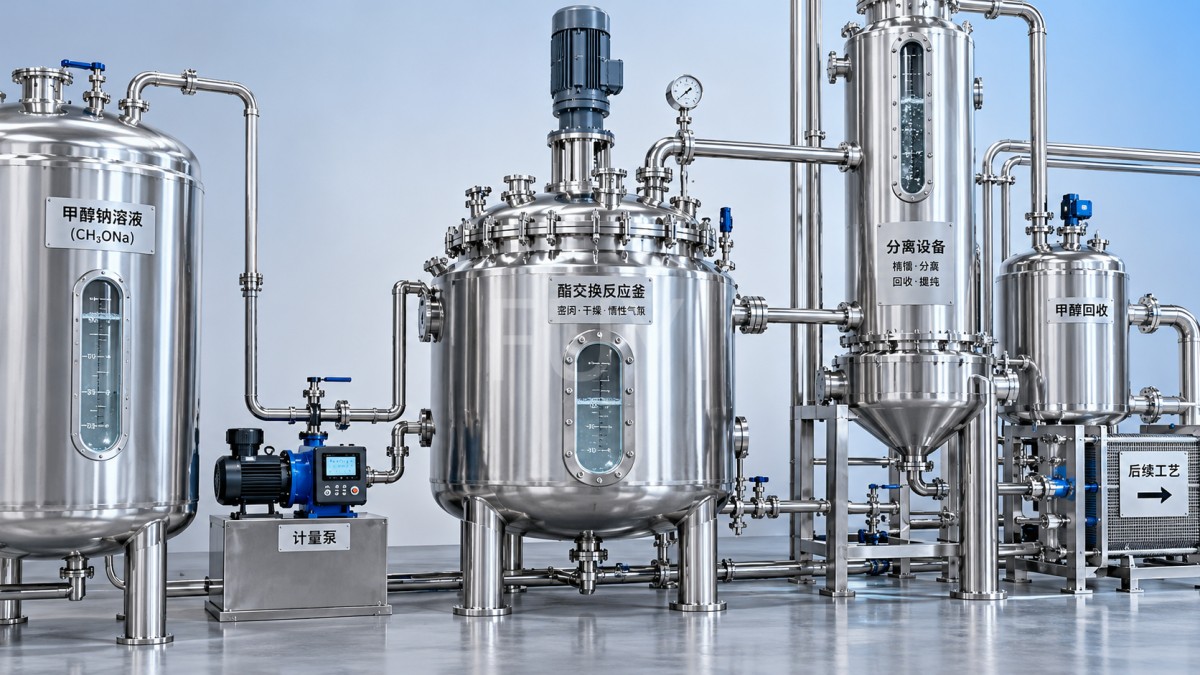
The deciding question is practical: does methoxide deliver the required conversion and selectivity without creating a harder purification problem? Reaction yield alone cannot answer that. Residual sodium, unwanted methyl esters, solvent recovery, and aqueous waste handling can all affect whether a route remains attractive at production scale.
Solid versus methanolic solution: more than a delivery choice
A methanolic solution can simplify enclosed transfer and metered addition when methanol is already compatible with the reaction. However, its concentration determines both the active sodium methoxide dose and the amount of solvent entering the process. Comparing delivered mass without correcting for active content can produce misleading consumption estimates.
Solid material avoids introducing methanol as the supplied carrier, but it does not automatically simplify processing. Charging, dissolution, dust exposure, and moisture exclusion become more prominent. Solubility in the selected medium and heat release during preparation or addition should be established before scale-up.
For either form, the specification needs to go beyond a headline assay. Researchers should establish:
- Whether the assay reports active alkoxide or another measure, such as total alkalinity.
- How water, hydroxide, and carbonate impurities are measured and controlled.
- Whether concentration and physical condition remain suitable over the intended storage period.
- Which residual impurities are acceptable in the finished intermediate.
These questions are especially relevant for suppliers offering crystalline and higher-concentration sodium alkoxide products. Zhenfeng Chemical’s stated activities span organic chemical production, research, and import-export trade, including alcohol-series and sodium ethoxide products. Such capabilities provide a basis for a technical discussion, but grade suitability still requires batch documentation and reaction-specific evaluation.
When a different alkoxide deserves consideration
Methoxide is relatively small and can participate in nucleophilic reactions. If that behavior causes unwanted chemistry, a more sterically hindered alkoxide may warrant screening. It is not a drop-in replacement: solvent compatibility, basicity in the selected medium, solubility, and side reactions can all change.
For comparison, Sodium tert-Pentoxide is offered for organic synthesis and applications involving pharmaceutical, dye, and ink intermediates. Its listed formula is C5H11NaO, molecular weight 110.13, and purity ≥99%. Those specifications identify the material; they do not establish equivalent performance to sodium methoxide. A meaningful comparison needs reaction screening and a clear understanding of the supplier’s assay method.
Moisture control connects performance with safety
Water reacts with sodium methoxide to form methanol and sodium hydroxide, changing the reagent composition. In ester-processing systems, moisture and acidic impurities can promote competing hydrolysis or soap formation. The consequences may include lower selectivity, difficult phase separation, and additional purification rather than simply reduced catalyst activity.
Air exposure also matters because moisture and carbon dioxide can alter alkoxide quality. Packaging, transfer arrangements, and storage practices must preserve the specified material through use. A satisfactory release assay is not enough if repeated opening or unsuitable handling changes the contents afterward.
Safety review must address the actual grade. Sodium methoxide is corrosive and moisture-reactive; methanolic solutions add methanol’s toxicity and flammability hazards. Addition, sampling, cleaning, and waste treatment require procedures based on the current safety data sheet and site assessment. Quenching should be engineered around heat release and exposure risks, not treated as an informal final step.
The next question is about the route, not the industry label
Sodium methoxide is worth evaluating when a defined downstream reaction calls for its basic or nucleophilic behavior and the process can accommodate its solvent and residues. It is a poor starting assumption for general refinery catalysis.
Before selecting a grade, clarify the desired transformation, feed acidity and moisture, allowable methanol input, and finished-product sodium limit. Then compare small-scale reaction results with the proposed workup and handling system. That sequence reveals whether sodium methoxide genuinely fits the process—or merely appears relevant because the feedstock is petrochemical-derived.
Leave A Message
If you are interested in our products and want to know more details, please leave a message here, we will reply you as soon as we can.