
Sodium butoxide granules can cake during storage because moisture has entered the container, particles have been compressed together, or residual liquid has made their surfaces more adhesive. Temperature changes can worsen these conditions, especially when a cold container is opened in warm, humid air. The critical distinction is whether the material has merely lost its free-flowing form or has also reacted with moisture and changed chemically.
A hard lump is therefore not just a dispensing problem. Breaking it apart does not establish that the product remains suitable for use. Before attempting to restore flow, check the packaging history, exposure conditions, and applicable quality requirements. If contamination or reaction is suspected, hold the material for assessment rather than adjusting the dose or forcing it through handling equipment.
Moisture can change both the granules and their chemistry
Sodium butoxide is a moisture-sensitive sodium alkoxide. Contact with water converts alkoxide into the corresponding alcohol and sodium hydroxide, releasing heat. For sodium n-butoxide, the simplified reaction is:
C4H9ONa + H2O → C4H9OH + NaOH
This matters because moisture-related caking is not necessarily ordinary dampness that can be removed by drying. Localized water exposure can create reacted surfaces and liquid-containing regions that bind adjacent particles. The resulting agglomerate may contain chemically altered material even when much of the container still looks normal.
Moisture can enter through an inadequately closed lid, a damaged liner, a compromised seal, or repeated exposure during dispensing. A scoop or transfer connection that looks dry can also introduce water if it has been washed and not dried under an approved procedure. Closing the drum afterward does not reverse that exposure.
Humid air also brings carbon dioxide into contact with the product. Sodium alkoxides can react with carbon dioxide, introducing additional changes in composition. Neither hydrolysis nor carbon dioxide exposure must produce an obvious color change. White granules or white lumps are not proof that the original quality has been retained.
Temperature changes matter mainly through condensation and surface conditions
A cold drum opened in a warmer room can collect condensation if exposed surfaces are below the surrounding air’s dew point. Water may form on the closure, handling tools, or product near the opening. A warehouse humidity reading alone will not identify this risk: the temperature difference at the moment of opening is important.
Where the supplier’s instructions permit, allow a cold container to equilibrate while sealed before opening it in the designated handling area. This is different from actively heating the material. Uncontrolled warming is not an acceptable way to remove lumps or suspected moisture.
Temperature cycling may also redistribute residual liquid within the package. Depending on the grade and its composition, liquid at particle contacts can promote adhesion or solid bridges. This mechanism requires a review of the product specification and storage history; it should not be assumed simply because the warehouse became warmer.
There is no universal storage temperature or humidity limit that can be assigned to every sodium butoxide grade. Use the supplier’s safety data sheet, technical instructions, and site procedure rather than borrowing limits from an unrelated salt.
Compaction can cause caking without proving degradation
Granules held under sustained pressure can pack more tightly and develop stronger particle contacts. Transport vibration, a deep product bed, and prolonged storage can contribute. Fine particles fill spaces between larger granules, increasing contact area and making the packed mass harder to discharge.
This provides a plausible physical explanation for caking in an unopened container with sound packaging. It does not rule out moisture ingress. Closure defects, liner damage, or exposure before sealing may remain hidden until the container is used.
Residual process liquid is another possible contributor. If a grade contains enough residual alcohol or other permitted volatile material to affect its surface behavior, particles may adhere more readily. This is a question for the supplier’s specification or investigation, not a reason to add solvent during handling.
The exact chemical identity also matters. Sodium n-butoxide and Sodium Tert-Butoxide are distinct alkoxides, although both are moisture-sensitive. A shared molecular formula does not make their physical behavior, analytical methods, or handling instructions interchangeable. Confirm the container label and safety data sheet before applying advice intended for another butoxide grade.
Use the location and timing of caking to guide the investigation
The distribution of lumps can help identify where to investigate, but it cannot establish chemical quality on its own.
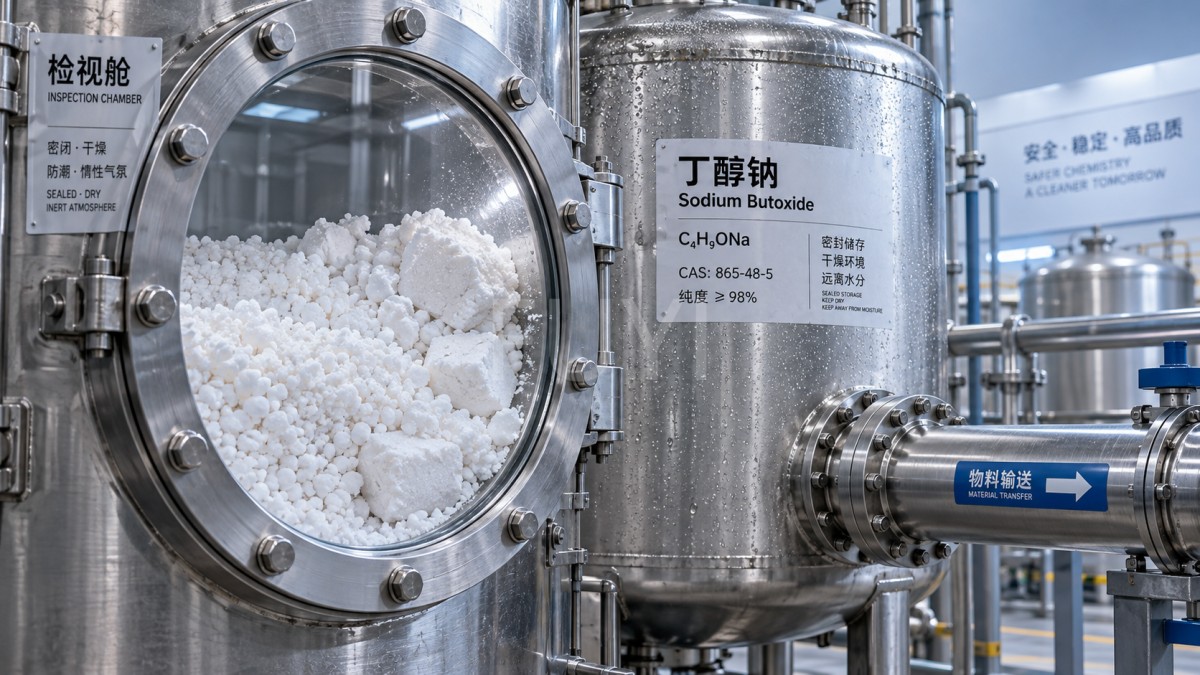
Record the lot number, receipt date, first-opening date, storage conditions, and extent of caking. Photograph accessible material only under the approved inspection procedure. Do not repeatedly open a container merely to monitor lump growth; that can introduce further exposure and make the original cause harder to establish.
Decide whether the material can be released, not just whether it can flow
Loose agglomerates in otherwise unchanged material and a hard, wet-looking crust require different assessments. Unexpected heat, leakage, container distortion, or signs of reaction warrant stopping routine handling and following the site’s incident procedure. Do not improvise opening, sampling, or disposal.
For a stable container without incident indicators, quality assessment should address chemical suitability as well as particle condition. Relevant supplier-approved tests may distinguish active alkoxide from free alkali and other degradation products. A total alkalinity result alone can be misleading because sodium hydroxide formed by hydrolysis also contributes to measured alkalinity.
Moisture testing likewise requires a method suitable for the reactive matrix. An unsuitable method can produce misleading results or introduce handling hazards. Appearance, lump hardness, and a single broad assay are not substitutes for the agreed release criteria.
If physical deagglomeration is permitted, it should be performed only under a validated procedure using compatible equipment and appropriate exposure controls. Hammering drums, uncontrolled crushing, or forcing lumps through a feeder can damage packaging, generate dust, and create unpredictable dosing. Adding water, alcohol, or another solvent to restore flow changes the material and may initiate a reaction.
Prevent recurrence at the container and transfer points
The most useful controls prevent exposure before caking begins:
- Preserve the packaging barrier. Inspect seals, closures, and liners, and reseal using the specified method rather than relying on a lid that merely appears closed.
- Control opening conditions. Minimize open time and use the dry atmosphere or closed-transfer arrangement required for the grade. Where inert gas is specified, its dryness and delivery conditions must be controlled.
- Keep contact equipment suitably dry. Use dedicated, compatible tools and an approved drying procedure after cleaning.
- Reduce repeated access. Match package size and dispensing arrangements to consumption, or use approved subdivision into compatible sealed containers.
- Respect storage and use limits. Track opened containers separately and follow the supplier’s shelf-life or retest instructions.
Do not place loose desiccant directly into the product unless the supplier explicitly approves that arrangement. It can introduce foreign material, and it does not restore alkoxide already consumed by moisture. For the same reason, drying a caked batch is not automatically a recovery method.
The practical decision is whether the storage event affected particle flow alone or also changed the reagent. Packaging and exposure records help explain the cause; appropriate testing establishes whether the material remains usable. Restoring discharge behavior is a separate task and should follow—not replace—that quality decision.
Leave A Message
If you are interested in our products and want to know more details, please leave a message here, we will reply you as soon as we can.