
Sodium methoxide can initiate anionic polymerization when methoxide attacks a suitable monomer and generates a chain end that remains capable of adding further monomer molecules. In laboratory screening, however, monomer disappearance or a temperature rise does not establish successful polymerization: the same reagent can also cause hydrolysis, transesterification, chain transfer, or formation of low-molecular-weight adducts.
The practical answer depends on monomer chemistry. Certain strongly activated vinyl monomers and suitable cyclic monomers can support methoxide-initiated growth; ordinary styrene and conjugated dienes generally cannot under conventional anionic polymerization conditions. Evaluating Sodium Methoxide in polymerization therefore starts with the proposed initiation and propagation mechanisms, not simply with whether the reagent is a strong base.
The decisive test: does the first reaction create a propagating chain end?
An initiator must do more than react with the monomer. Its initial addition must produce an active species that repeatedly reacts with additional monomer. For vinyl polymerization, this usually means creating a carbon-centered anion stabilized by the monomer’s substituents. In ring-opening polymerization, methoxide can open a suitable ring and generate an oxygen-centered chain end.
Three reactions need to be distinguished:
- Productive initiation: methoxide forms a new chain end that continues adding monomer.
- Single addition or substitution: methoxide consumes monomer but gives a product unable to propagate.
- Base-mediated side reaction: methoxide promotes elimination, exchange, or another transformation without initiating the intended polymer.
A proposed mechanism should identify the first bond formed, the location of the resulting negative charge, and the next propagation step. If that sequence cannot be justified, increasing initiator concentration is unlikely to solve the problem and may increase unwanted chemistry.
Monomer families have very different suitability
The distinction between styrene and cyanoacrylates illustrates why “vinyl monomer” is too broad a selection category. Cyanoacrylate substituents strongly activate the double bond and stabilize the resulting anion. Styrene supports anionic propagation once an appropriate chain end has been generated, but that does not mean methoxide can generate it efficiently.
Ring-opening systems require a separate judgment. An alkoxide can attack ethylene oxide and leave an alkoxide terminus available for further ring opening. With lactones, initiation may also be possible, but the same nucleophile can attack ester linkages already present in the growing polymer. Polymer formation and controlled polymer formation are therefore different claims.
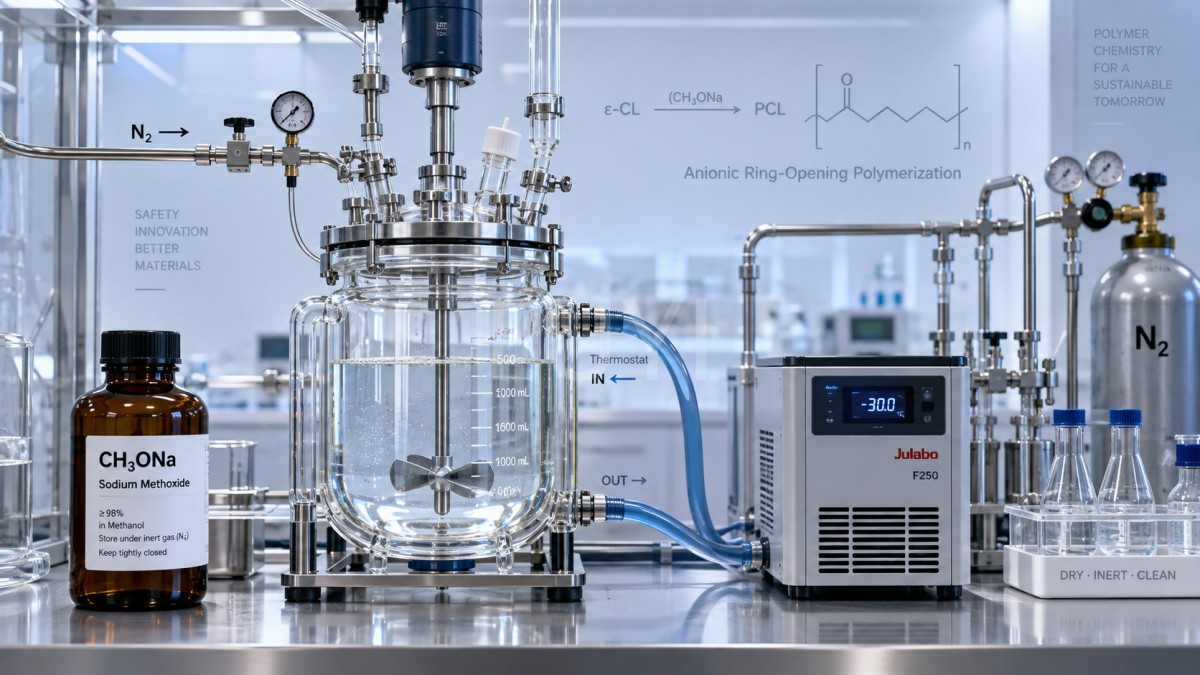
Why a feasible system can still give poor polymer control
Solvent changes both reactivity and chain population
Sodium methoxide may be supplied as a solid or in methanol solution. These forms are not automatically interchangeable. Methanol participates in proton exchange with alkoxide chain ends and can act as a transfer agent, changing the number of chains and the achievable molecular weight.
For carbanionic propagation, proton donors generally deactivate the chain end. In alkoxide-mediated ring-opening polymerization, exchange with an alcohol can instead regenerate an initiating alkoxide and redistribute growth among chains. Whether alcohol is an unwanted impurity or a deliberate component depends on the intended mechanism.
Solvent polarity and coordinating ability also affect sodium–anion association, reagent solubility, and aggregation. A solvent change can alter initiation relative to propagation, even when nominal reagent concentrations remain unchanged. Solvent selection should follow a validated monomer-specific procedure rather than a generic preference for polar solvents.
Water and carbon dioxide change the effective reagent
Water reacts with sodium methoxide to produce methanol and sodium hydroxide. Carbon dioxide exposure can introduce carbonate species. These changes affect the available methoxide concentration and may create alternative initiation or side-reaction pathways.
A high total alkalinity result alone does not establish high active methoxide content. Hydroxide and carbonate can contribute to alkaline assays without behaving like methoxide in the intended reaction. Reagent qualification should distinguish active alkoxide, water, residual alcohol, and relevant inorganic impurities using suitable analytical methods.
Temperature presents another trade-off. Heating may improve dissolution or accelerate propagation, but it can also increase transfer, backbone exchange, or degradation. Cooling may suppress side reactions while making initiation too slow relative to propagation. Either imbalance can broaden the molecular-weight distribution.
A screening sequence that separates reaction from polymerization
When a trial gives unexpected viscosity or incomplete conversion, repeat testing should establish which chemical event occurred before changing the recipe.
- Define the intended pathway. Identify whether the target is vinyl addition or ring opening, and determine whether methoxide should be incorporated into the initiating end group.
- Characterize the inputs. Record monomer inhibitor content, water, solvent composition, reagent assay, and any alcohol introduced with the initiator. Do not remove stabilizers without an appropriate safety assessment.
- Use informative controls. Compare the proposed system with a no-initiator control and, where technically justified, a validated reference initiator. Keep conditions comparable enough to identify spontaneous polymerization or impurity effects.
- Measure more than conversion. Combine residual-monomer analysis with molecular-weight characterization. Use end-group analysis where feasible to test whether the proposed initiation pathway occurred.
- Assess transfer and side products. Unexpected oligomers, cyclic species, or molecular weight below the intended target may indicate additional chain starts or competing reactions.
For an ideal system without transfer, number-average molecular weight should increase with converted monomer per initiating site. Treat that relationship as a diagnostic expectation, not a guaranteed calculation: incomplete initiation, alcohol exchange, and chain transfer invalidate a simple monomer-to-initiator prediction.
Comparing another sodium alkoxide without assuming equivalence
A related reagent can help evaluate whether an alkoxide pathway is appropriate, but substitution requires fresh validation. The listed Sodium Ethoxide has formula C2H5NaO, molecular weight 68.06, and CAS number 141-52-6. Its stated specifications are total alkali ≥99%, free alkali ≤1.0%, and sodium carbonate ≤0.5%.
These specifications provide starting points for reagent comparison, not evidence of polymerization-grade suitability. Confirm assay definitions, moisture, and residual alcohol before use. Replacing methoxide with ethoxide changes the initiating group and may change solubility, aggregation, and reaction rates; equal reagent mass also does not provide equal molar loading.
Where screening must stop before scale-up
Rapidly polymerizing activated monomers can release heat faster than laboratory observations suggest. Ethylene oxide introduces additional toxicity, flammability, and pressure hazards, while sodium methoxide requires protection against moisture exposure and corrosive contact. Scale-up needs reaction calorimetry, compatible equipment, controlled charging, and a validated stopping or quenching strategy.
Proceed only when testing demonstrates reproducible initiation, meaningful chain growth, acceptable side-product levels, and a manageable thermal profile. If methoxide mainly produces adducts or low-molecular-weight material, changing to an established monomer-specific initiator system is more defensible than treating greater basicity or higher loading as the solution.
Leave A Message
If you are interested in our products and want to know more details, please leave a message here, we will reply you as soon as we can.