
When to choose sodium ethoxide for pharmaceutical intermediates
Choosing sodium ethoxide for pharmaceutical intermediate synthesis requires more than comparing base strength or purchase price. The useful question is whether its reactivity, solvent compatibility, and impurity profile fit the intended transformation and downstream purification. It can be a practical choice for selected condensation, substitution, and deprotonation steps, particularly in ethanol-compatible systems. But a successful laboratory reaction does not automatically establish that the same reagent form, concentration, or dosing method will work reliably in production.
The strongest reason to select it is a good match between chemistry and plant operation. The weakest is simply that it is available at an attractive price.
Start with the transformation—not a ranking of bases
Sodium ethoxide provides both basicity and nucleophilicity. That combination can help or hurt. In a suitable condensation, base activity is useful; with an electrophile susceptible to ethoxide attack, unwanted ethoxy substitution may compete with the intended pathway. For elimination-sensitive substrates, increasing temperature or extending exposure to the base may also change selectivity.
Claisen-type condensations involving ethyl esters are a familiar setting in which an ethoxide base can make chemical sense. Matching the alkoxide to the ester’s alkoxy group helps avoid introducing a different ester group through exchange. This is a compatibility argument, not a guarantee of conversion: substrate acidity, competing reactions, and product behavior still determine whether the route is workable.
Deprotonation needs particular care. Sodium ethoxide is not a universal substitute for stronger bases used to generate less stabilized carbanions. If the route depends on quantitative formation of a weakly acidic intermediate, assess the relevant equilibrium in the actual solvent rather than relying on a generic base-strength chart. Conversely, where a milder base already gives acceptable conversion and selectivity, additional basicity may only increase degradation or complicate quenching.
For chiral intermediates, monitor stereochemical integrity as well as yield. An apparently clean conversion can still be unacceptable if prolonged basic exposure promotes epimerization at a susceptible center.
Ethanol compatibility is a process decision
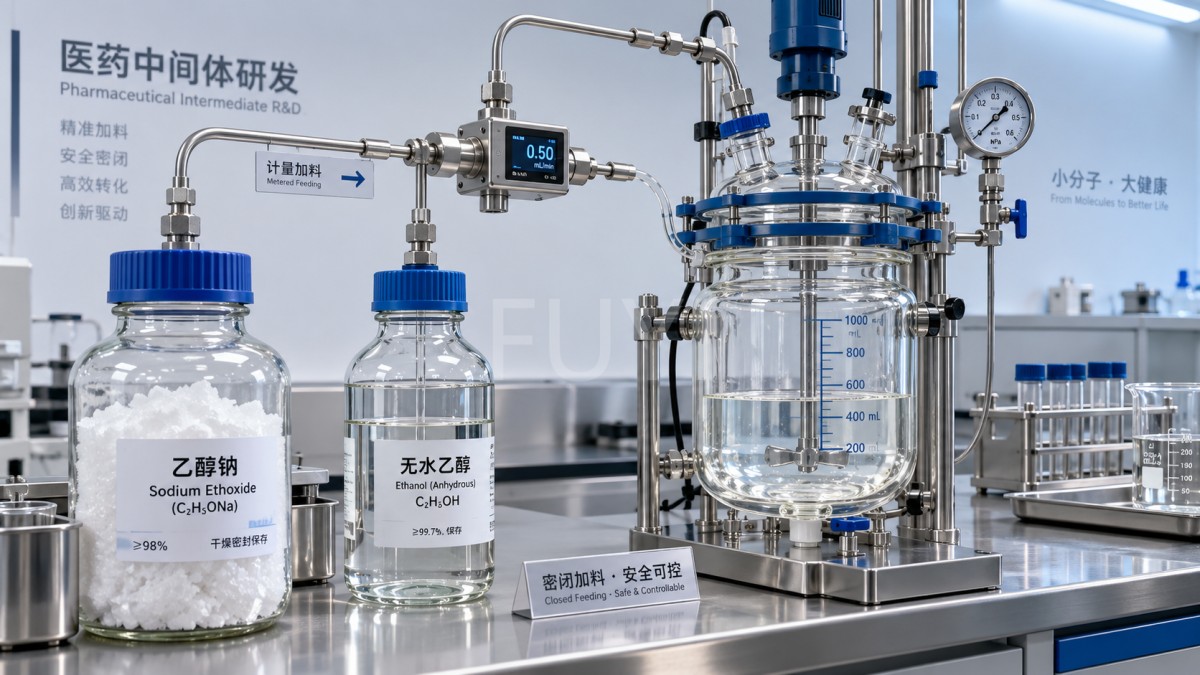
An ethanolic solution is convenient when ethanol is already acceptable in the reaction and isolation sequence. It can simplify enclosed transfer and metered addition, avoiding routine charging of a moisture-sensitive solid. However, the carrier solvent becomes part of the process mass balance. A dilute solution may introduce enough ethanol to alter substrate concentration, crystallization behavior, or solvent recovery requirements.
Ethanol is not always an innocent carrier. It can participate in proton transfer and ester exchange, and it may interfere with chemistry requiring strictly aprotic conditions. If the laboratory procedure uses a different solvent, replacing solid reagent with an ethanolic solution should be treated as a process change, not merely a purchasing substitution.
Compare sodium methoxide, sodium hydroxide, carbonate bases, or less nucleophilic bases only against the route’s actual requirements. Methoxide changes the possible exchange products; hydroxide introduces different hydrolysis risks; carbonate may be insufficiently reactive. The relevant comparison is conversion, impurity formation, isolation performance, and operating burden together.
Crystalline material or solution: choose around the charging system
Crystalline sodium ethoxide can be useful when solvent loading must remain low or the process cannot tolerate the solvent supplied with a commercial solution. The trade-off is physical handling. Moisture exposure, agglomeration, dissolution rate, and solids transfer all deserve evaluation. Particle characteristics can influence charging consistency even when two batches have similar chemical assays.
Solutions are often easier to meter, but concentration, density, viscosity, and low-temperature behavior must suit the equipment. Do not assume every concentrated grade stays homogeneous throughout storage and transfer. Confirm the supplier’s recommended temperature range and examine what happens during realistic transport or warehouse conditions.
Zhenfeng Chemical’s stated production scope includes crystalline particles and high-concentration sodium alkoxide products, alongside organic chemical production, research, and trade. For route evaluation, that breadth is useful only if the proposed grade comes with defined specifications, handling guidance, and dependable batch documentation. Manufacturing capability alone does not establish suitability for a particular pharmaceutical intermediate.
Read the assay alongside the impurity profile
A headline assay can hide differences that matter in synthesis. Moisture consumes sodium ethoxide, producing ethanol and sodium hydroxide. Exposure to carbon dioxide can also change the material’s composition. Depending on the analytical method, an acid-base titration may report total alkalinity without adequately distinguishing active ethoxide from other basic species.
Before approving a grade, clarify the following points with the supplier:
- Whether assay is reported as active sodium ethoxide, total alkalinity, or another defined basis.
- How water is measured, including whether the method is suitable for a reactive alkoxide matrix.
- Whether hydroxide, carbonate, and insoluble matter are controlled where relevant to the route.
- For solutions, the solvent identity, concentration basis, and any density data needed for volumetric dosing.
- How packaging, storage time, and change control protect the agreed specification.
There is no single water or assay limit that fits every pharmaceutical intermediate. Set acceptance criteria from reaction sensitivity and impurity fate. If a small change in base composition alters hydrolysis or isolation, a broad commercial specification may need tightening.
The same discipline applies to other route inputs. For example, Aniline is listed as a pharmaceutical raw material with CAS 62-53-3 and purity of at least 98%. That nominal purity does not establish suitability for every synthesis. Its tendency to darken on exposure to air or sunlight makes storage history relevant, while related impurities need route-specific assessment. Its inclusion in a supply portfolio should not be read as evidence that sodium ethoxide is suitable for its deprotonation.
Transfer the dosing strategy, not just the recipe
On scale-up, average reactor temperature can conceal high local base concentration near the addition point. Mixing, dissolution, and feed location may therefore affect selectivity. Evaluate heat release, cooling capacity, and credible dosing deviations before transferring a laboratory addition rate to production.
Quenching deserves equal attention. Sodium ethoxide reacts exothermically with water and acids, while ethanolic formulations introduce flammability considerations. Use the relevant safety data sheet and process hazard assessment to define enclosed handling, exposure controls, inerting where appropriate, and a validated quench sequence. These decisions should reflect the actual formulation and equipment.
The final selection should rest on representative-batch trials that track conversion, related impurities, stereochemical purity where relevant, filtration, and isolation—not yield alone. Choose sodium ethoxide when its chemistry fits the substrate, its formulation fits the plant, and its specification controls the impurities the route cannot tolerate. If one of those conditions remains uncertain, resolve it before fixing the production grade.
Leave A Message
If you are interested in our products and want to know more details, please leave a message here, we will reply you as soon as we can.