
Inline monitoring advances chemical innovation by making changes inside a production process visible early enough to act on them. In salt crystallization and sodium-based manufacturing, that means tracking concentration, particle formation, or reaction conditions while the process is running, rather than discovering a deviation after sampling, laboratory analysis, and material transfer.
The important shift is not simply faster measurement. It is the ability to connect a measured change with a controlled response: adjusting cooling, modifying feed rates, delaying an endpoint, or investigating an unexpected reaction profile. That connection can improve consistency and support scale-up, but only when the measurement represents the process reliably and the operating team knows what action it justifies.
From measuring equipment conditions to observing product formation
Temperature, pressure, flow, and vessel level remain essential process measurements. However, they do not fully describe what is happening to the material. Two crystallization batches can follow the same cooling program yet produce different particle distributions because their impurity levels, seed properties, mixing conditions, or initial concentrations differ.
Inline analytical tools extend visibility beyond equipment conditions. Spectroscopy can track selected chemical components where suitable calibration is available. Refractometers and density instruments can indicate concentration in well-characterized mixtures. Particle probes and imaging systems can reveal changes in crystal populations. These technologies answer different questions; none provides a complete picture independently.
This distinction shapes the direction of monitoring projects. A sensor selected to confirm feed concentration is not necessarily suitable for detecting nucleation or identifying a trace impurity. The useful starting point is the unresolved operating decision, not the instrument catalogue. If an additional measurement would not change an action, establish an endpoint, or explain a quality deviation, its production value is limited.
Crystallization shows why timely data matters
Salt crystallization is a strong application because final product quality depends on the path taken through the process, not just the final composition. Supersaturation drives crystal growth and nucleation. Excessive supersaturation can generate unwanted fines, while insufficient driving force can extend the batch cycle. Concentration and temperature measurements help estimate this condition, provided the solubility relationship is established for the actual liquor composition.
Particle monitoring adds another layer. Focused beam reflectance measurement, for example, tracks chord-length distributions rather than directly measuring a conventional particle-size distribution. Its signal can indicate changes in particle populations, but interpretation depends on particle shape, solids concentration, and probe placement. Treating the output as an interchangeable replacement for laboratory particle sizing can create misleading conclusions.
A more useful arrangement combines solution-state measurements with particle information. An increase in small-particle counts during cooling may justify reviewing the cooling rate or seed strategy. A concentration trend without corresponding crystal growth may point toward delayed nucleation, measurement drift, or a mixing problem. The combined evidence narrows the investigation; it does not automatically establish the cause.
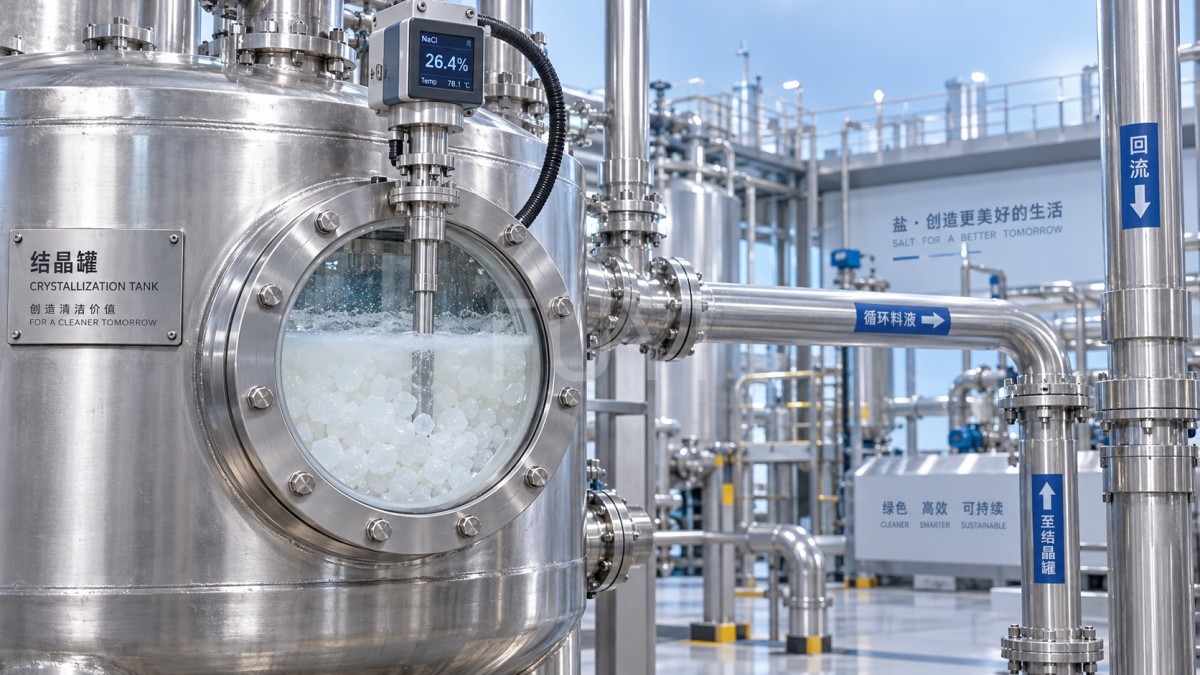
The production consequences extend beyond the crystallizer. Excess fines can complicate filtration, washing, and drying. Changes in crystal habit can affect handling and downstream processing. Monitoring therefore creates value when its signals are linked to those outcomes, rather than assessed only by how frequently the instrument records data.
The innovation opportunity is a shorter experimental loop
Offline testing remains necessary, but it provides snapshots. Inline monitoring supplies a process history between those snapshots. During development, that history can show when a reaction slows, when nucleation begins, or how a feed change affects the system. It helps distinguish a process that reaches the desired result reliably from one that reaches it through an unstable operating path.
This is particularly relevant to scale-up. Larger vessels change mixing, heat transfer, and local concentration gradients. A successful laboratory recipe cannot be transferred solely by preserving temperatures and ingredient ratios. Measurements collected during pilot operation can help establish which process features must remain comparable and which operating settings need adjustment.
However, a probe measures its local environment. A signal near a feed point may differ from conditions elsewhere in the vessel. Scale-up work must therefore consider sensor location alongside agitator performance, feed-entry design, and circulation patterns. Otherwise, detailed data can produce false confidence in a poorly represented process.
The practical advance is a shorter feedback loop between experimentation and manufacturing decisions. Teams can evaluate whether a revised feed strategy reduces concentration excursions or whether a different seeding approach changes the onset of fines. Laboratory results then confirm whether those observed changes deliver the intended product attributes.
Analytical capability is not the same as release authority
The distinction between process control and product release is important in facilities handling both salts and organic intermediates. A concentration signal may be sufficient to guide an operating adjustment while remaining insufficient to certify final purity.
For example, a stated purity of at least 99% for Ethyl Chloroacetate, an intermediate used in organic synthesis, cannot be established merely by a stable density or refractive-index reading. Minor contaminants may require a selective laboratory method. Inline monitoring can support endpoint assessment or flag deviations only where the analytical relationship has been demonstrated for the relevant process mixture.
The same limitation applies to salt production. A conductivity reading does not uniquely identify individual ions in a mixed solution. Density can change with temperature or composition. Spectroscopic models can lose accuracy when feedstocks introduce components absent from the calibration set. A reliable monitoring strategy defines both what the signal measures and what it cannot prove.
Integration and maintainability determine production value
The demanding part of an inline monitoring project is often the installation rather than the instrument’s nominal capability. Crystallizing streams can coat optical windows, obstruct narrow passages, or expose probes to abrasion. Concentrated salt solutions require corrosion assessment based on the complete process chemistry, temperature, and cleaning conditions.
Reactive sodium-based systems need a separate compatibility review. Where sodium alkoxides or other moisture-sensitive materials are involved, probe seals, maintenance procedures, and any sampling arrangements must preserve containment and exclude incompatible substances. An instrument suitable for an aqueous salt stream should not be assumed suitable for an alcohol-based reactive process.
Placement also creates trade-offs. Direct vessel installation avoids a sampling delay but may complicate access. A bypass arrangement can improve serviceability, yet cooling, pressure changes, or residence time may alter the sample before measurement. In crystallization, a bypass can even create or dissolve particles, making its signal unrepresentative of the vessel.
Project acceptance should therefore cover performance under operating conditions: response time, signal availability, fouling behavior, cleaning recovery, and agreement with reference methods across the intended range. A successful demonstration in a clean, stable liquid is not enough to establish performance in a changing slurry.
Moving toward control requires stronger evidence
Continuous measurement creates the technical basis for moving from fixed recipes toward condition-based control. Cooling rates can respond to estimated supersaturation; feed rates can respond to reaction progress. These approaches are valuable where they manage a demonstrated source of variability, not simply because automated control is available.
A prudent implementation separates observation from intervention. Data collection first establishes relationships with quality and operating events. Advisory limits can then be evaluated before automatic adjustments are enabled. Closed-loop control requires validated measurement performance, suitable control logic, and defined behavior when the signal becomes unavailable or unreliable.
Inline analysis can support hazard detection, but it should not be treated as a substitute for independent protective functions without the appropriate engineering assessment. Calibration drift, fouling, communication failure, and model error all need consideration when a measurement influences an operating action.
The strongest investment case connects monitoring to a specific recurring loss: avoidable rework, extended processing, inconsistent filtration, or uncertain endpoints. Its cost includes installation, reference testing, model upkeep, maintenance access, and downtime—not just the sensor. The direction worth watching is the integration of composition and particle measurements into dependable production decisions. More data becomes chemical innovation only when it enables a process improvement that can be demonstrated, maintained, and transferred to manufacturing scale.
Leave A Message
If you are interested in our products and want to know more details, please leave a message here, we will reply you as soon as we can.