
Choose a methanolic solution when methanol is compatible with your reaction and you need repeated, convenient dosing. Choose solid sodium methoxide when you need control over the solvent or concentration and have suitable facilities for handling a moisture-sensitive powder. For either form, reliable results depend on the reagent’s actual assay, its condition after opening, and the accuracy of your dosing method.
Selecting sodium methoxide for laboratory use therefore starts with the reaction conditions, not the purchase price. A solution can simplify routine work, but its methanol becomes part of the experiment. A solid offers more formulation freedom, but weighing and dissolving it introduce additional opportunities for exposure, contamination, and dosing error.
Start with the solvent your experiment can tolerate
A commercial methanolic solution supplies both sodium methoxide and methanol. That is often convenient when the procedure already uses methanol, particularly for repeated additions or a series of experiments performed at the same concentration. It avoids preparing a fresh stock solution from powder each time.
The decision changes when methanol affects the chemistry. It is a protic solvent, so it can consume reagents that are incompatible with alcohols, influence reaction pathways, and change the solvent composition. Even when it does not prevent the reaction, the amount introduced with the base may affect comparisons between experiments.
Solid sodium methoxide allows you to avoid introducing methanol as a supplied carrier solvent. However, that does not mean it will dissolve readily or behave identically in any alternative medium. In some solvents, it may form a suspension, making stirring and representative transfer important. Other alcohols can also participate in alkoxide exchange, so changing the solvent may change the reagent species present.
If a published or validated procedure specifies methanolic sodium methoxide, changing to the solid is a method change. Match the solvent composition, concentration, and addition conditions before expecting equivalent behavior.
Compare the forms against your actual workflow
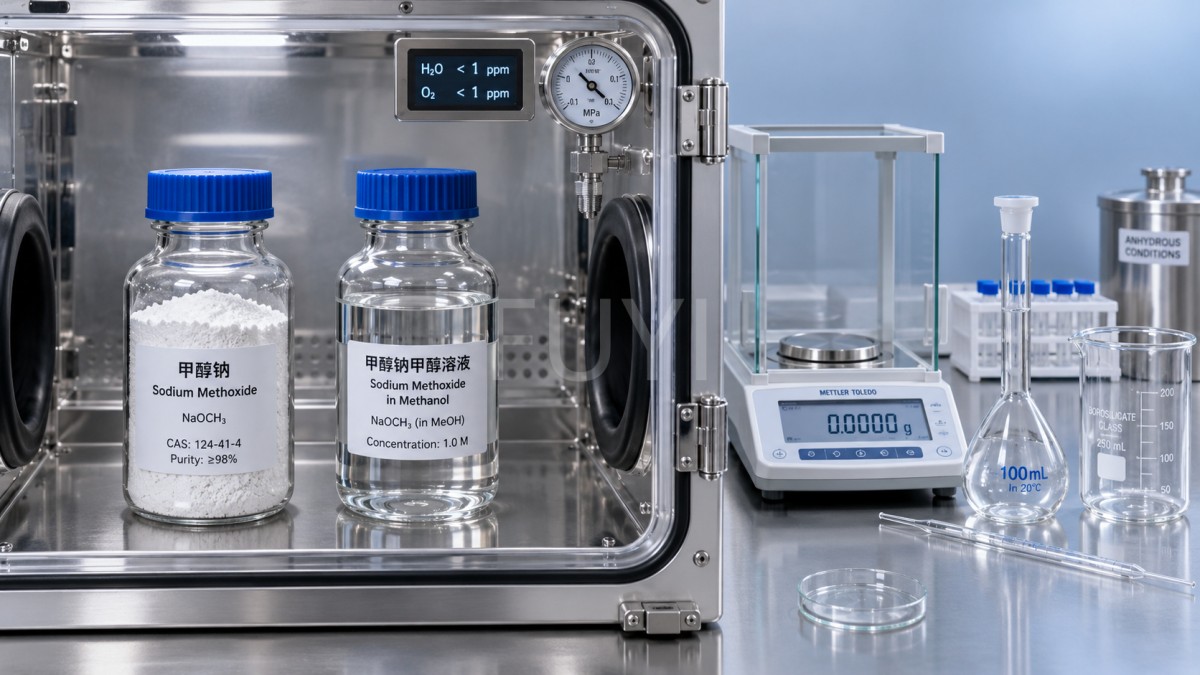
For routine work in methanol, a suitable solution will often reduce preparation time and make additions more consistent. For occasional experiments requiring different concentrations or restricted methanol content, a small package of solid may be more practical. The advantage depends on whether the laboratory can maintain the reagent’s condition throughout handling.
Dosing accuracy depends on what the specification means
Solid purity and solution concentration describe different things. A solid assay concerns the composition of the supplied material. A solution concentration describes how much sodium methoxide is present relative to the solution’s mass or volume. Neither should be interpreted simply as “strength” without reading the stated basis.
For solutions, distinguish mass percentage, mass per volume, and molarity. A concentration expressed by mass cannot be converted directly into a volume dose without an appropriate density value. Temperature also matters when converting between mass and volume or when accurate volumetric dosing is required.
A useful calculation framework is:
- Solid: reagent mass × assay fraction ÷ molar mass.
- Solution specified by mass fraction: solution mass × sodium methoxide mass fraction ÷ molar mass.
- Solution specified by molarity: solution volume in liters × molarity.
These calculations assume that the material still matches its stated composition. A certificate of analysis describes the supplied batch; repeated exposure after opening can undermine that starting point.
For very small additions, weighing solid directly may be less reproducible because the balance uncertainty becomes large relative to the required mass. A suitably diluted, homogeneous solution can improve dosing, provided the dilution is prepared accurately and remains stable under the storage conditions.
Where the experiment depends strongly on base equivalents, use a validated assay or standardization method appropriate to the application. An acid–base titration may measure total alkalinity rather than methoxide specifically. Hydroxide or other basic impurities can contribute to the result, so a satisfactory titration alone does not establish the reagent’s chemical composition.
Moisture control matters for both forms
Sodium methoxide reacts with water to form methanol and sodium hydroxide. This changes the reagent composition rather than merely diluting it. A mixture may remain strongly basic while behaving differently in a reaction that depends on methoxide concentration or low water content.
Carbon dioxide exposure can also alter the composition through carbonate-containing species. For sensitive work, the relevant questions are how often the container is opened, how long transfers take, and whether the equipment and atmosphere provide the dryness required by the procedure.
Solid material can develop lumps or crusting after exposure, although appearance alone cannot establish its condition. A clear solution is not proof of an unchanged assay either. Precipitation, unexpected solids, or changes in handling behavior should trigger assessment under the laboratory’s reagent-control procedure.
Package size is therefore part of reagent selection. A large container may have a lower purchase cost per unit but require many openings before it is consumed. Smaller containers can reduce repeated exposure and simplify stock rotation. Choose a quantity that fits realistic consumption, and record opening dates and any subsequent assay results.
Convenient dispensing still requires controlled handling
Both forms are strongly basic and can cause severe chemical injury. Solid handling adds the possibility of airborne powder and contamination around the weighing area. Methanolic solutions add methanol’s toxicity and flammability, alongside the corrosive hazard of the dissolved reagent.
Use the product’s safety data sheet to select protective equipment, containment, storage conditions, and compatible transfer equipment. Gloves must suit the complete formulation, including the solvent. Ventilation and ignition control are particularly relevant when working with methanolic solutions.
Preparing a solution from solid also introduces a heat-management task. Dissolution and contact with moisture can release heat, so the vessel, cooling arrangements, and addition method belong in the approved procedure. The time spent on preparation, cleaning, and waste handling should be included when comparing the cost of the two forms.
Keep reagent identity separate from physical form
Related sodium alkoxides may appear in the same supplier catalog, but choosing a different alkoxide is a chemical decision. For example, Sodium tert-Pentoxide is offered for organic synthesis and related chemical manufacturing. Its different alkoxy group means it cannot be treated as an interchangeable version of sodium methoxide; steric effects, solubility, and reaction behavior may differ.
If a procedure requires sodium methoxide, compare solid and solution grades of that reagent first. Consider another alkoxide only when the reaction design supports the change.
What to establish before placing an order
Set the purchasing specification around the experiment: acceptable solvent, required concentration, assay basis, relevant water and impurity limits, and a package size that suits consumption. Request a batch certificate that reports the properties your work actually depends on. A high headline purity does not replace a relevant water specification or explain how the assay was measured.
For repeated work in methanol, select a solution with a documented concentration and a practical dispensing format. For solvent-sensitive work or varied stock preparation, select solid only after establishing suitable handling and preparation conditions. The better choice is the form that delivers the required reagent consistently, with manageable exposure, preparation effort, and dosing uncertainty.
Leave A Message
If you are interested in our products and want to know more details, please leave a message here, we will reply you as soon as we can.