
How to keep anhydrous sodium butoxide dry during reactor charging
Keeping Sodium Butoxide anhydrous dry during reactor charging protects reagent quality and helps control process risks. Brief exposure to humid air can introduce moisture, causing hydrolysis, heat release, and changes in reaction performance. Effective moisture control starts before the container is opened—with verified dry equipment, a suitable inert-gas system, and a charging procedure that minimizes atmospheric contact. Storage, transfer connections, and reactor readiness all need attention, alongside site safety procedures and the supplier’s safety data sheet.
The weak point is often not the unopened package. It is the short gap between removing a closure and establishing a protected transfer path. A damp adapter, an inadequately dried hose, or a reactor drawing in room air can compromise otherwise acceptable material.
Understand what moisture changes
Sodium butoxide is an alkoxide salt, not an ordinary moisture-tolerant inorganic salt. Water reacts with it to form butanol and sodium hydroxide. That changes the composition of the reagent: a batch may still contain strong base, but no longer have the intended alkoxide content. Depending on the chemistry, this can affect conversion, selectivity, impurity formation, or downstream separation.
Air exposure also introduces carbon dioxide, which can consume alkoxide and alter composition. An inert atmosphere therefore does more than exclude humidity. However, inert gas does not reverse prior degradation, and a nitrogen label on a supply line does not prove that the gas reaching the charging point is dry.
Release the whole charging path—not just the reactor
A vessel that looks dry may retain water around valve seats, sampling branches, gaskets, or low points. After aqueous cleaning, use the approved drying procedure and its acceptance criteria. Elapsed drying time alone is weak evidence unless the method has been validated for that equipment configuration.
The same check must cover everything between the package and the vessel. Removable funnels, charging locks, flexible connections, and tools can be overlooked because they sit outside the main reactor cleaning record.
- Confirm that product-contact equipment is clean, compatible, and released as dry.
- Check that dried components remained capped or otherwise protected during storage.
- Verify the moisture specification of any solvent already in the reactor.
- Inspect connections and seals that could admit ambient air during transfer.
- Confirm that the vent route and pressure protection are available before establishing inert-gas flow.
Do not adopt a universal water-content or dew-point limit from another process. Set limits using reagent specifications, reaction sensitivity, equipment capability, and the approved risk assessment. Any analytical method used for release must be suitable for the sample matrix; measuring water in a reactive alkoxide requires particular care.
Choose a protected transfer method
For solid material, a sealed charging interface or suitable inerted transfer enclosure generally offers better moisture exclusion than an open funnel. The choice depends on package design, particle characteristics, batch size, and the plant’s handling equipment. Powder flow, dust containment, and static-control requirements must be assessed alongside dryness.
Where an approved process uses a solution or slurry, closed transfer may reduce atmospheric exposure. It also introduces another moisture source: the carrier solvent. Changing from solid charging to liquid transfer is a process change, not merely a handling convenience. Solvent compatibility, concentration, reaction heat, and transfer reliability need review.
A useful pre-job walkdown follows the actual route: sealed package, protected connection, transfer device, reactor inlet, and vent. At each interface, ask where air could enter and how dryness is verified.
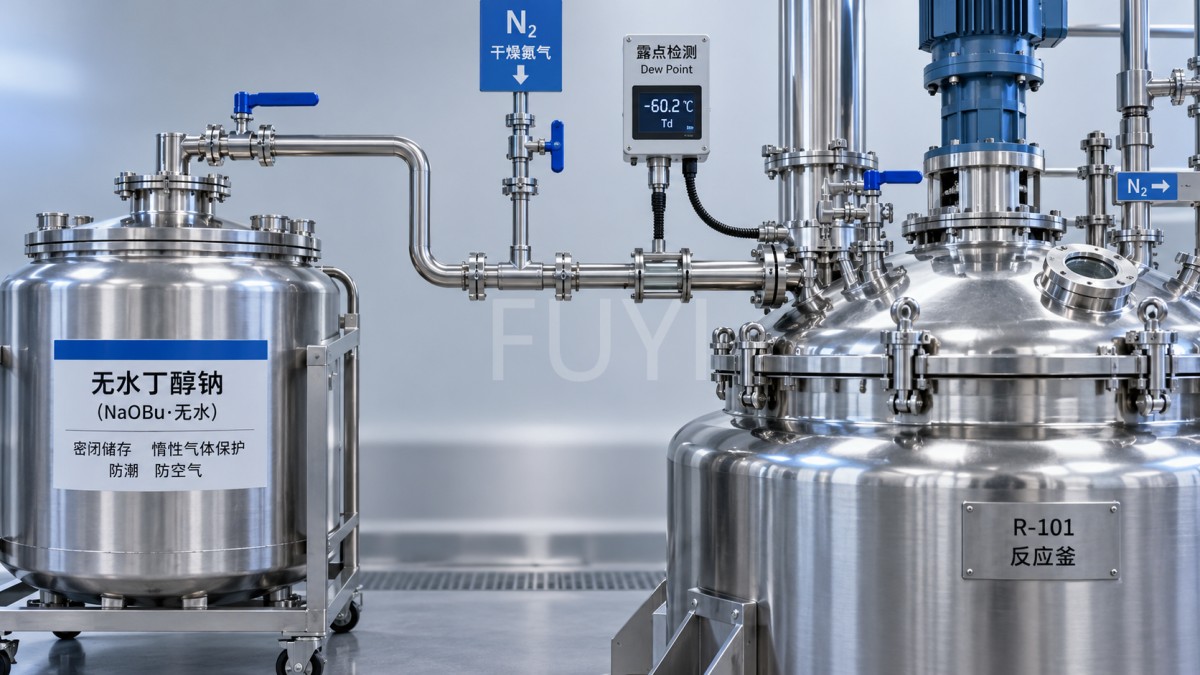
Dry nitrogen needs verification at the point of use
Nitrogen is commonly used for moisture-sensitive charging, subject to process compatibility. Check the supply specification, distribution system, and any local drying equipment. A dry header can still feed a wet branch after maintenance or prolonged disconnection. Where required, verify gas moisture near the charging equipment rather than relying only on the bulk supply specification.
Use the approved purge arrangement and operating limits. Increasing gas flow indiscriminately can entrain dust, disturb solids transfer, or overload vent handling. Never improvise container pressurization. Nitrogen also presents an oxygen-deficiency hazard, so ventilation and site exposure controls remain essential.
Control the opening, charging, and interruption
Before opening, confirm the material identity, batch documentation, packaging condition, and readiness of the complete transfer system. If a sealed container has come from cold storage, follow an approved conditioning procedure before opening; condensation can occur when cold surfaces meet warmer, humid air.
Prepare connections and tools in advance so the package is not left exposed while someone searches for an adapter. Establish the validated inerting condition before exposing the reagent. During charging, monitor the process variables specified in the batch instruction, including temperature and pressure where applicable. Moisture exclusion does not replace control of reagent-addition heat.
If transfer stops, follow the defined interruption procedure: isolate and protect both sides of the connection. Avoid leaving an open hopper unattended under the assumption that flowing nitrogen will keep it dry. Air can enter through gaps or during pressure changes.
Unexpected warming, altered flow, or unusual agglomeration warrants investigation, although appearance alone cannot confirm moisture contamination. Suspend charging when required by the procedure and involve process safety and quality personnel. Do not attempt improvised drying or compensate with extra reagent.
Check the other materials and close the documentation gap
Protecting the alkoxide will not help if another charge introduces unacceptable water. In a synthesis that also uses Diethyl Oxalate, an organic intermediate with molecular formula C6H10O4 and molecular weight 146.14, its incoming specification and handling conditions need separate review. Its pharmaceutical-intermediate applications do not establish suitability for a particular sodium butoxide reaction.
Supplier discussions should resolve practical uncertainties. Zhenfeng Chemical’s stated activities include crystalline and high-concentration sodium products, organic-chemical production and research, and import-export supply. For this charging task, the useful questions concern the exact supplied form, assay basis, moisture specification, package closure, storage requirements, and technical guidance for partial-container use—not a general description of production capability.
Record equipment dry-release status, relevant gas checks, container opening, interruptions, and deviations. Protect any remaining material using the supplier-approved closure procedure and site controls. Before the next charge, verify three things: the reagent remains acceptable, the entire transfer path is dry, and the inert atmosphere can be maintained through completion.
Leave A Message
If you are interested in our products and want to know more details, please leave a message here, we will reply you as soon as we can.