
In alkoxide manufacturing, moisture control protects product strength, batch consistency, and handling safety. Quality and safety teams need limits that reflect both chemistry and operating conditions.
Sodium ethoxide and related alkoxides react with water, forming alcohols and hydroxides while releasing heat. This reaction can undermine specifications and create localized thermal hazards.
Chemical production therefore requires moisture control across raw materials, reactors, transfer systems, and packaging. Testing finished products alone cannot prevent contamination introduced earlier in the process.
The practical priority is to identify water entry points, establish validated acceptance criteria, and respond to deviations before affected material reaches downstream users or storage.
What actually happens when water reaches an alkoxide?
For sodium ethoxide, the simplified reaction is sodium ethoxide plus water forming ethanol and sodium hydroxide. Water therefore consumes the intended alkoxide and changes composition.
The resulting hydroxide can affect downstream reactions, impurity profiles, and customer performance. Depending on formulation and conditions, contamination may also change clarity or solids behavior.
Hydrolysis releases heat, but the actual temperature rise depends on water quantity, addition rate, concentration, mixing, and cooling. Small localized ingress can produce uneven heating.
For safety assessment, distinguish alkoxide hydrolysis from reactions involving residual metallic sodium. Alkoxide hydrolysis does not itself generate hydrogen; residual sodium reacting with water does.
Where metallic sodium may remain, the hazard assessment must address hydrogen generation and ignition potential. Alcohol vapor and combustible materials introduce additional concerns around heat release.
Product form also matters: crystalline material and concentrated solutions have different exposure patterns, mixing behavior, and heat removal needs. Controls should reflect the actual grade.
Which quality results can conceal moisture damage?
A batch can pass a broad alkalinity test while its useful alkoxide content has declined. Hydroxide formed during hydrolysis may contribute to the measured alkalinity.
Consequently, total alkalinity should not automatically be treated as proof of sodium ethoxide purity. The analytical method must distinguish relevant species or demonstrate suitable selectivity.
Quality teams should define acceptance criteria for active content, relevant impurities, and physical condition. The required tests depend on the product specification and downstream application.
Water measurement also requires care. Karl Fischer testing can be useful, but reactive, strongly basic matrices require validated preparation, reagents, and checks for analytical interference.
A low measured water result does not prove that moisture never entered the batch. Water may already have reacted, leaving hydroxide and altered active content.
Investigations should therefore compare water results with composition data, process records, and sampling conditions. This combined evidence is more useful than any isolated laboratory value.
Where does water enter chemical production?
Start with incoming alcohols, solvents, and other feeds. Supplier certificates help, but storage conditions and transfer practices can change moisture content before materials reach production.
Inspect tanks, reactor surfaces, low points, and dead legs after cleaning or maintenance. Residual rinse water can remain even when accessible surfaces appear visibly dry.
Transfer lines, hoses, pumps, and filters create additional exposure points. Equipment opened to humid air may require a verified drying procedure before returning to service.
Blanketing gas can also introduce moisture if its supply quality is unsuitable. Check the specification at the point of use, including distribution lines and regulators.
Sampling ports deserve particular attention because repeated opening can expose product to ambient humidity. A contaminated sample can also trigger misleading investigations and unnecessary batch rejection.
Finally, assess containers, closures, and filling equipment. Dry product can deteriorate after manufacture when packaging contains moisture, seals leak, or repeated opening admits humid air.
How should QC teams set meaningful moisture limits?
There is no universal moisture limit suitable for every alkoxide product. Limits must reflect chemical sensitivity, grade, customer requirements, analytical capability, and the manufacturing process.
Define limits separately for feeds, blanketing gas, equipment readiness, and finished product where relevant. These measurements serve different purposes and should not be treated as interchangeable.
Use a material balance to connect feed moisture with potential alkoxide loss. For sodium ethoxide, each mole of reacting water consumes one mole of alkoxide.
This relationship helps estimate chemical consumption, but it does not predict temperature rise or reaction rate. Thermal assessment requires appropriate experimental data and process engineering review.
Set action thresholds early enough to prevent an unacceptable final batch. Consider measurement uncertainty, sampling variation, expected process contribution, and the time needed for corrective action.
Trend results by supplier, equipment train, and storage duration. Repeated upward movement can reveal deteriorating controls before individual measurements cross the formal rejection threshold limits.
Which operating controls deserve the most attention?
Use closed handling where practical, supported by suitable dry gas protection and compatible equipment. Reduce unnecessary openings during charging, transfer, filtration, sampling, and container filling.
After wet cleaning, require documented drying and a defined release check before introducing alkoxide. A fixed drying time alone may not establish readiness across different equipment.
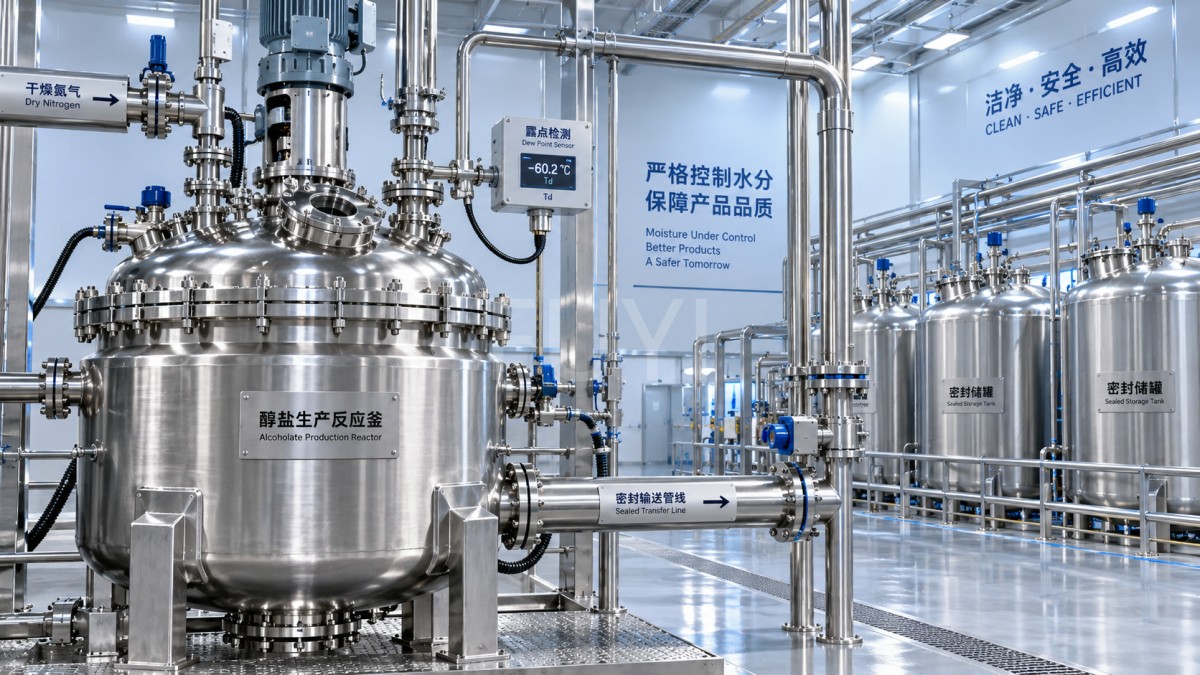
Monitor gas dryness with suitable instrumentation, but interpret dew point against stated pressure and measurement conditions. Establish alarms and responses appropriate to the protected process.
Dryness and inerting are separate requirements. A dry gas does not automatically provide adequate oxygen control, and an inert gas does not automatically meet moisture specifications.
Where nitrogen blanketing is used, safety procedures should address pressure control and oxygen deficiency hazards. These requirements belong alongside moisture controls in the operating procedure.
For credible water ingress scenarios, evaluate cooling capacity, isolation arrangements, and emergency response. Operators need predefined actions grounded in site procedures and the applicable safety data.
How should teams handle a suspected moisture excursion?
When moisture ingress is suspected, identify and isolate affected material under established procedures. Prevent further exposure and preserve records needed to determine the source and extent.
Review temperature behavior, feed results, gas quality, maintenance history, and transfer events. Check whether the deviation affected one sample, one container, or the wider batch.
Resample using a validated dry technique when sampling contamination is plausible. An acceptable repeat result should support an investigation, rather than automatically erase the original finding.
Do not assume that removing water restores product quality. Hydrolyzed alkoxide has already changed chemically, and drying cannot reverse the formation of hydroxide by itself.
Release, reprocessing, or disposal decisions require authorized technical review against specifications and process safety requirements. Document corrective measures that address the entry point and recurrence risk.
Keep related intermediates under their own specifications
Facilities handling alkoxides may also manage other organic intermediates. Shared purchasing or storage arrangements should preserve product identity, compatibility, and the specific acceptance criteria for each.
One example is Methyl Methoxycetate, a colorless, transparent liquid supplied for organic synthesis and pharmaceutical, pesticide, and fragrance applications, with a stated purity specification of at least 99%.
Its listed molecular formula is C4H8O3, molecular weight is 104.10, and CAS number is 6290-49-9. Verify these identifiers against current supplier documentation during qualification and receipt.
This ester intermediate is chemically distinct from an alkoxide, so its moisture requirements need separate justification. Alkoxide handling limits should not automatically become its release criteria.
Listed packaging includes 200 kg galvanized iron drums and customer requested options. Confirm container compatibility, closure integrity, and storage requirements using the current product documentation.
Make moisture control a release requirement throughout production
Strict moisture control succeeds when prevention, measurement, and response work together. Final testing provides evidence, while dry feeds, prepared equipment, and protected transfers prevent damage.
For QC teams, the decisive question is whether results demonstrate suitable active content and impurity control. For safety teams, it is whether credible ingress scenarios are controlled.
A reliable alkoxide process assigns measurable criteria and clear responsibilities at each exposure point. That approach supports consistent chemical production, defensible batch release, and safer handling.