
Solvent selection can determine whether potassium tert-butoxide delivers reproducible polymerization performance or introduces variability in reaction rate and polymer properties. No solvent is universally optimal.
For technical evaluators assessing Potassium tert-Butoxide in polymerization, the key considerations extend beyond solubility to ion pairing, solvent polarity, moisture control, and monomer compatibility.
These factors can influence initiation efficiency, side reactions, and molecular-weight distribution, depending on the system. Evaluation must therefore connect solvent behavior with the actual polymerization mechanism.
This article examines how solvent choice affects reagent behavior and outlines practical criteria for comparing solvent systems during laboratory evaluation and subsequent process development work.
First establish what potassium tert-butoxide does in your reaction
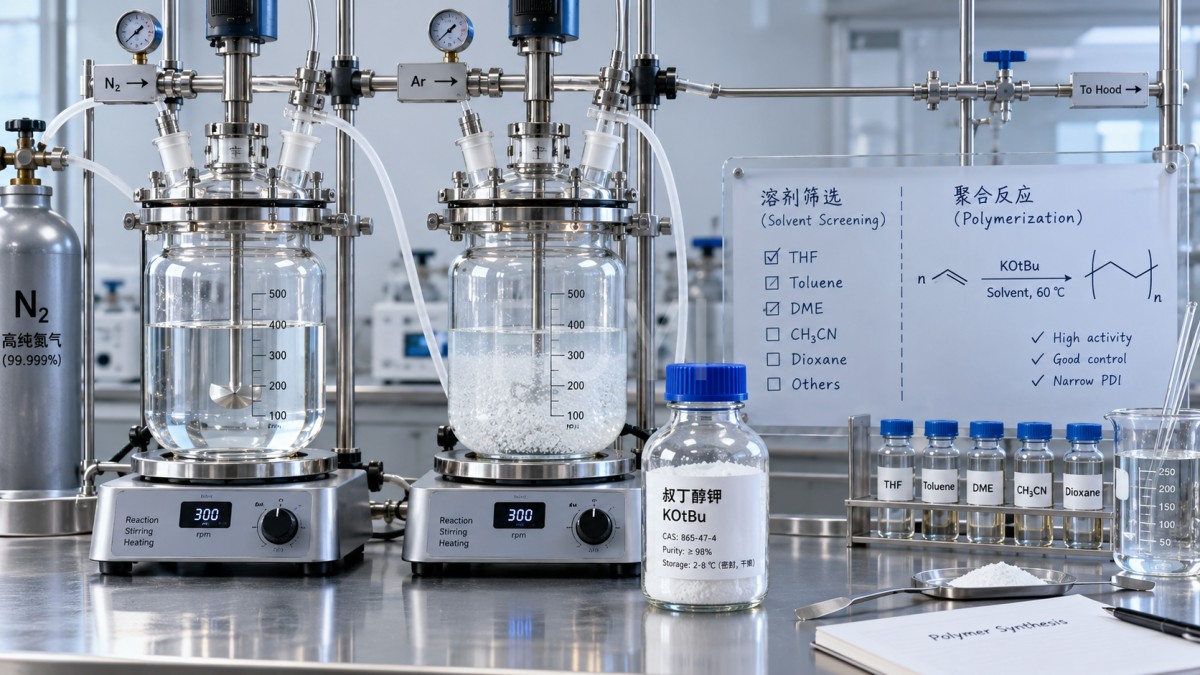
Potassium tert-butoxide is a strong base that can generate reactive species through deprotonation or participate directly in initiation, depending on the monomer and reaction conditions.
Its presence alone does not establish a controlled anionic polymerization. The reactive chain end, initiation pathway, and competing reactions must be identified before selecting solvents.
For example, an alkoxide may initiate some ring-opening polymerizations, while other systems require deprotonation of a precursor. Those pathways impose different requirements on solvent compatibility.
In base-mediated step-growth reactions, solvent choice may primarily affect deprotonation, transport, and byproduct removal. Molecular weight then depends strongly on stoichiometry and functional-group conversion as well.
Start by defining the reagent’s intended role and acceptable product attributes. A solvent that accelerates conversion may still produce unacceptable branching, end groups, or dispersity.
Why polarity and potassium coordination change performance
Potassium tert-butoxide can exist as associated species rather than isolated ions. Solvents alter this association, changing the accessibility and reactivity of the tert-butoxide anion.
Solvent polarity and donor ability are related but distinct properties. Coordination to potassium can modify ion pairing even when differences in bulk polarity appear modest.
Ether solvents such as tetrahydrofuran often coordinate potassium and improve reagent dispersion. Depending on the system, this can change initiation rate, propagation, and competing reactions.
Hydrocarbon solvents generally provide weaker coordination and may leave substantial reagent undissolved. Performance can consequently depend on particle characteristics, agitation, temperature, and the addition sequence.
Stronger coordination does not guarantee better polymer quality. Increased anion availability may accelerate desired chemistry while also promoting chain transfer, elimination, or attack on sensitive functionalities.
For an initiating system, assess whether initiation becomes more uniform relative to propagation. Faster overall conversion alone cannot demonstrate efficient initiation or improved molecular-weight control.
Which solvent families deserve consideration?
Use solvent families to organize screening, not to assign universal rankings. Monomer solubility, growing-polymer solubility, and chemical compatibility can outweigh favorable behavior toward the reagent.
Alcohols deserve particular scrutiny because proton exchange can change the alkoxide population. Protic media may also terminate sensitive chain ends or introduce chain-transfer pathways.
High polarity is not evidence of inertness. Carbonyl-containing solvents and other potentially reactive media require specific compatibility assessment before use with potassium tert-butoxide under process conditions.
Likewise, chlorinated solvents should not be default choices for strong-base chemistry. Assess possible decomposition and reaction pathways rather than relying only on physical solvent properties.
Mixed solvents can balance coordination and polymer solubility. Record the exact composition, because small changes in donor-solvent content may change reaction behavior and reproducibility.
Moisture control must be measured, not assumed
Water consumes potassium tert-butoxide, producing tert-butanol and potassium hydroxide. This changes the effective reagent composition and may introduce additional initiation, transfer, or hydrolysis pathways.
The significance of moisture depends on its amount relative to reactive sites. A seemingly small water concentration can matter when the intended initiator concentration is low.
Measure solvent water content with an appropriate validated method, commonly Karl Fischer titration. Include monomer, reagent, transfer equipment, and atmosphere in the moisture-control assessment.
For moisture-sensitive systems, drying procedures should support a measurable specification. Describe storage conditions and allowable exposure time so that laboratory results can transfer between operators.
Review reagent assay and impurity information alongside water measurements. Nominal purity alone may not distinguish active alkoxide from hydroxide, carbonate, or residual alcohol contributions.
Separate solvent chemistry from mixing and solubility effects
A cloudy mixture does not automatically indicate failure, but it complicates interpretation. An apparent induction period may reflect dissolution or mixing rather than slow chemical initiation.
Keep temperature, reagent concentration, addition order, agitation, and sampling consistent during comparisons. Otherwise, solvent effects can become confounded with differences in transport or local concentration.
Monitor polymer solubility throughout conversion, not only at charging. Precipitation or rising viscosity can change heat removal, sampling reliability, and contact between active species and monomer.
If a solvent improves homogeneity, determine whether the benefit persists at realistic solids loading. A dilute screening result may disappear when polymer concentration increases during development.
For scale-up, evaluate reaction heat and mixing requirements before increasing batch size. Solvent changes can shift the timing of heat release even at similar final conversion.
Build a comparison that supports a technical decision
Select a small candidate set covering plausible coordination and solubility differences. Use documented reagent quality and measured water content to make the comparisons interpretable across runs.
For each candidate, measure conversion over time, isolated yield, molecular weight, dispersity, and relevant impurities. Add end-group analysis when initiation efficiency or transfer is central.
Use a molecular-weight method appropriate to the polymer. Conventional size-exclusion chromatography calibration can introduce bias, so distinguish apparent molecular weight from independently supported absolute values.
Where initiator-based molecular-weight prediction is justified, compare measured values with expectations from conversion and initiator loading. Deviations require investigation rather than automatic attribution to solvent polarity.
Repeat promising conditions sufficiently to assess variability. Consistent polymer properties across runs usually provide stronger evidence of suitability than the fastest result from one experiment.
Define acceptance criteria before ranking candidates: conversion window, molecular-weight range, maximum dispersity, impurity limits, and practical isolation requirements. Weight these criteria for the intended application.
Include purchasing quality and downstream processing in the assessment
Request specifications, batch certificates, and handling information for reagents and solvents. Supplier technical support is most useful when it addresses measurable attributes affecting your reaction.
In broader pharmaceutical-intermediate sourcing, Diemethyl oxalate is listed at ≥99% purity, with formula C4H6O4, molecular weight 118.09, and CAS number 553-90-2 in the supplied specification.
This separate intermediate should not be inferred to function as a polymerization solvent or additive. Its listed melting point of 54 °C warrants clarification of delivery form.
For polymerization solvents, include removal efficiency, residual-solvent requirements, recovery feasibility, and waste treatment in the decision. Favorable reaction kinetics may be offset by difficult purification.
Confirm that solvent recycling preserves the required water and impurity specifications. Fresh-solvent performance does not establish that recovered material will produce equivalent polymer quality consistently.
Choose the solvent that preserves control across realistic conditions
The best solvent for Potassium tert-Butoxide in polymerization supports the intended mechanism while maintaining reproducible conversion, molecular-weight characteristics, and manageable processing under relevant operating conditions.
Make the final selection using controlled comparisons of coordination effects, moisture, phase behavior, and product quality. Advance candidates that meet predefined criteria across repeat experiments.
Where results remain sensitive to small operating changes, resolve the cause before scale-up. A defensible solvent choice explains both acceptable performance and the conditions needed to maintain it.