
Qualify a Sodium Tert-Butoxide supplier by demonstrating repeatable performance across independent production lots, supported by reliable analytical methods, protective packaging, and documented manufacturing controls.
A certificate of analysis establishes reported quality, but technical evaluators need evidence that the supplied material performs consistently under their actual process conditions.
Moisture exposure, active alkoxide content, impurities, and handling behavior can change reaction outcomes. Trial batches should connect these material attributes with measurable production requirements.
The strongest qualification decision combines predefined acceptance criteria, representative sampling, controlled process comparisons, and clear supplier commitments for routine supply and future material changes.
What must a trial batch prove before you approve the supplier?
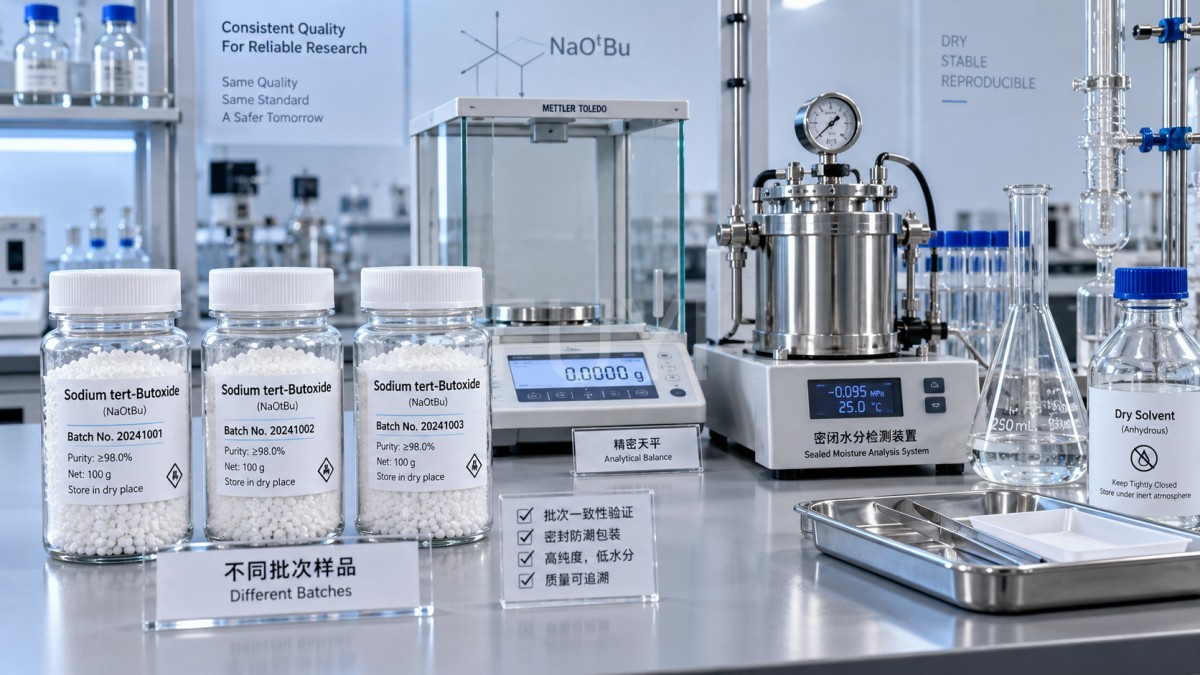
Start with the process failure modes that matter: incomplete conversion, unwanted byproducts, inconsistent dosing, filtration difficulties, or material deterioration after opening and subsequent storage.
Translate those risks into acceptance criteria before receiving samples. Otherwise, evaluators may rationalize disappointing results or select favorable measurements after the trial has finished.
Specify the required product form, whether solid or solution, together with assay basis, solvent identity where applicable, packaging configuration, and intended storage conditions explicitly.
For solutions, distinguish active material concentration from overall purity. For solids, define whether reported assay values refer to material as received or another basis.
Agree on critical attributes, analytical methods, and reporting limits with the supplier. Generic purity claims cannot establish equivalence when methods measure different chemical properties.
Do not adopt universal numerical limits without process evidence. A specification suitable for one synthesis may be inadequate for another reaction or impurity requirement.
Are the samples representative of future deliveries?
Request samples from independent manufacturing lots, preferably produced on different dates. Several containers filled from one batch demonstrate packaging variation rather than manufacturing consistency.
Three independent lots provide a practical starting point for many evaluations, although the required number should reflect process sensitivity, supplier history, and qualification requirements.
Ask whether samples came from routine production, pilot equipment, or specially prepared material. Qualification should establish a defensible connection between tested samples and commercial supply.
Record manufacturing date, lot identification, sampling date, container type, seal condition, and transport history. These details help explain discrepancies between supplier and laboratory results.
Use commercial packaging where practical, or request evidence that sample packaging provides comparable protection. A laboratory bottle may conceal weaknesses in the intended delivery container.
Define sampling and retention procedures under appropriate moisture control. Exposure during sample preparation can distort results and incorrectly attribute laboratory handling problems to manufacturing.
Which analytical checks distinguish usable material from a reassuring certificate?
Measure active alkoxide using a method demonstrated to distinguish the intended species from relevant degradation products. Total alkalinity alone may overstate usable alkoxide content.
Where acid titration is used, establish what the method actually measures. Hydroxide, carbonate, or other basic species may contribute, depending on the analytical procedure.
Assess water with a method validated for this reactive matrix. Direct Karl Fischer testing should not be assumed suitable without checking interference and recovery.
Choose impurity testing according to the manufacturing route and your process. Potential targets include residual alcohol, solvent impurities, degradation products, and relevant trace metals.
For solid grades, assess particle characteristics, agglomeration, and transfer behavior when these affect dosing or dissolution. Appearance should support evaluation rather than replace chemical testing.
For solution grades, verify concentration, solvent composition, and homogeneity under defined conditions. Investigate deposits or concentration differences before interpreting reaction performance from individual samples.
Compare supplier results with your laboratory findings using equivalent methods and sample handling. Resolve meaningful discrepancies before approving specifications or accepting routine shipments independently.
How should you compare trial performance without misleading results?
Run the candidate material against an approved reference under matched conditions. Control substrate lots, equipment, solvent quality, dosing accuracy, temperature management, and sampling practices.
Normalize comparisons to verified active content where appropriate. Equal gross weights can deliver different effective base amounts and obscure the actual cause of performance differences.
Include repeat runs where needed to estimate process variation. One successful reaction provides limited evidence if normal experimental variability exceeds the observed supplier differences.
Track conversion, selectivity, isolated yield, impurity formation, and workup behavior. Select the endpoints that determine whether your process produces acceptable material reliably at scale.
Also document dissolution time, transfer losses, deposits, and filtration behavior. These observations can explain operational problems that are invisible in the final yield result.
If your synthesis portfolio also uses Ethyl Chloroacetate, qualify that reagent separately; its stated purity of at least 99% does not establish suitability for every process.
It is listed for organic synthesis and pharmaceutical, pesticide, and fragrance applications, with 200 kg galvanized iron drums or customer-requested packaging requiring separate compatibility review.
Investigate failed trials systematically before retesting. Check analytical differences, exposure history, dosing calculations, and substrate variability, then document the cause and any corrective action.
Will packaging and technical support preserve performance after delivery?
Trial results should cover the intended receiving and handling workflow. Sodium tert-butoxide is moisture-sensitive, so packaging integrity and controlled transfer directly influence usable quality.
Review the safety data sheet and supplier handling instructions before testing. Apply site procedures for appropriate containment, protective equipment, storage, and response to accidental exposure.
Check closure integrity, container compatibility, seal traceability, and evidence supporting shelf life. Storage recommendations should identify conditions, rather than simply stating a nominal expiry date.
Where operationally relevant, evaluate material after a defined storage period or controlled opening cycle. Keep these studies within approved procedures and representative handling conditions.
Assess technical support through specific questions about methods, batch deviations, packaging performance, and change control. Useful answers should include records or technically defensible explanations.
Zhenfeng Chemical’s stated organic chemical production, research, and trade activities provide business context. Supplier approval still requires sodium tert-butoxide-specific manufacturing records and trial evidence.
What evidence justifies approval, conditional approval, or rejection?
Summarize each independent lot against the predefined criteria, including analytical results, process outcomes, handling observations, and unresolved deviations. Preserve individual results alongside averages for review.
Approve the supplier when representative lots meet requirements consistently and supporting controls are credible. Set incoming inspection requirements according to remaining uncertainty and process consequences.
Use conditional approval only when outstanding issues have defined corrective actions, responsible owners, and completion dates. Specify any restrictions on quantity, applications, or release.
Reject or defer qualification when performance failures remain unexplained, traceability is incomplete, or commercial material cannot be connected reliably to the successful trial samples.
Record change-notification expectations for manufacturing site, process, raw materials, specifications, and packaging. Define which changes trigger additional review or repeat qualification before routine use.
A qualified Sodium Tert-Butoxide supplier provides repeatable process performance and evidence explaining that consistency. Trial batches establish approval only when testing represents future supply.