
A cleaning trial can look successful while leaving the evaluator with a harder question: did the acid remove the scale without damaging the equipment or compromising the next production batch? Choosing formic acid technical grade requires more than comparing acid strength or purchase price. Suitability depends on deposit chemistry, substrate compatibility, impurity limits, and the conditions under which cleaning takes place.
Technical-grade material can be a practical candidate for carbonate scale and some acid-soluble mineral residues. It is less attractive when deposits are chemically resistant, equipment is corrosion-sensitive, or residual contaminants must meet demanding product-contact requirements. The useful decision is not simply “technical grade or higher purity,” but whether a defined material specification fits a validated cleaning process.
Start with the deposit—not the acid concentration
In salt-processing and organic chemical plants, similar-looking deposits can require very different treatments. A pale crust might contain calcium carbonate, crystallized sodium salts, silica, or a mixture of minerals and organic material. Appearance alone is not a reliable basis for acid selection.
Formic acid reacts with carbonate deposits, producing formate salts, water, and carbon dioxide. This makes it worth evaluating for carbonate-rich scale in suitable piping, heat exchangers, and process vessels. However, dissolution performance depends on scale composition, thickness, access to the surface, and the solubility of reaction products.
For mixed scale, removing the carbonate fraction may expose a resistant layer rather than complete the job. Evaluate representative deposits, not only a readily soluble laboratory sample. A treatment that loosens solids also needs a way to flush or capture them without plugging downstream passages.
What “technical grade” must mean in your purchasing specification
Technical grade is a commercial designation, not a universal impurity profile. Two suppliers can offer the same nominal acid concentration while differing in chloride, metals, nonvolatile residue, or other contaminants. For a technical evaluator, the certificate of analysis matters more than the grade name.
Request limits and test methods for parameters that affect the application:
- Formic acid assay: establishes the active acid supplied and supports consistent dilution calculations.
- Water content: affects formulation and the amount of concentrated material required.
- Chloride: deserves particular attention where stainless steel or other chloride-sensitive alloys are exposed.
- Metals and nonvolatile residue: can affect surface cleanliness, discoloration, or subsequent product quality.
- Other organic or inorganic impurities: should be evaluated against process-contact and wastewater requirements.
Concentrated commercial grades are feedstocks for preparing a cleaning solution; their supplied concentration is not automatically the appropriate working concentration. Compare quotations on the basis of usable acid content and verified specifications, then include dilution, inhibitor, rinsing, and waste-treatment costs.
Higher purity is justified when a particular impurity creates an unacceptable risk. It does not automatically make the cleaning process noncorrosive, nor does it replace rinse validation in pharmaceutical, food-contact, or other tightly controlled operations.
Compatibility is a system-level question
The vessel shell is only one part of the wetted system. A cleaning circuit may include welds, pump seals, valve seats, gaskets, instrument connections, and several metals. An acceptable result on one stainless-steel coupon does not establish compatibility with every component.
Carbon steel and other reactive metals can suffer significant attack. Stainless-steel performance varies with alloy, acid concentration, temperature, contaminants, and exposure time. Elastomers and plastics also require checks against the actual diluted formulation, including any inhibitor or surfactant.
Avoid treating “organic acid” as a synonym for “safe on metal.” Formic acid is corrosive, and a successful descaling reaction can occur alongside unacceptable metal loss. Where an inhibitor is proposed, verify that it is intended for formic acid, the relevant metallurgy, and the planned operating conditions. Inhibitor suitability should be demonstrated, not inferred from its use with another acid.
A useful qualification sequence links deposit removal to equipment protection:
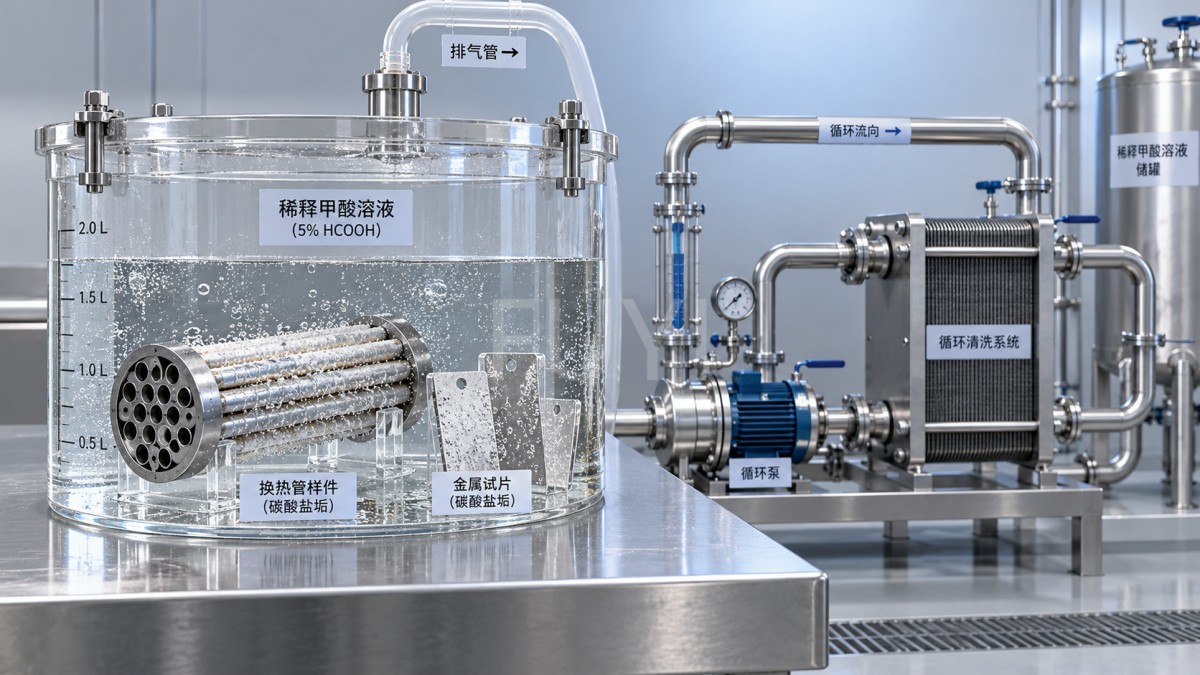
- Identify the deposit and all wetted materials.
- Test representative scale with the proposed diluted formulation.
- Run corrosion and seal-compatibility tests under realistic conditions.
- Check rinseability, residual contamination, and spent-liquor behavior.
- Conduct a controlled equipment trial with predefined acceptance criteria.
Define the operating window before approving the material
More acid or more heat may accelerate dissolution, but either can also increase corrosion and exposure risks. Set working concentration, temperature, contact time, and circulation conditions together. There is no single concentration that is suitable for every industrial cleaning job.
Carbonate dissolution releases carbon dioxide. Gas accumulation, foaming, and pressure buildup must be addressed in the cleaning arrangement; a closed, unvented circuit is not an acceptable assumption. Acid attack on some metals can also generate hydrogen, adding a separate flammability concern.
Cleaning progress should be judged through relevant measurements: remaining deposit, acid consumption, dissolved-metal levels, flow recovery, or heat-transfer performance. pH alone is a weak endpoint because it does not fully describe remaining acid capacity or scale removal.
The rinse stage needs its own acceptance criteria. These may include conductivity, pH, specific contaminant testing, or product-contact requirements. Neutralizing acid in place without removing the resulting salts can exchange one residue problem for another.
Where technical-grade material earns its place
Technical-grade formic acid is most defensible when carbonate-rich deposits dominate, the equipment tolerates the validated formulation, and the supplied impurities remain below process-specific limits. It is particularly worth considering in maintenance applications where effective flushing is available and ultra-low residual contamination is not required.
Consider tighter purity specifications when trace contaminants threaten the next product batch or sensitive surfaces. Consider a different cleaning chemistry when the deposit is predominantly silica, resistant sulfate scale, or organic fouling. Where simple sodium salt crystallization is the issue, assess water solubility before introducing acid.
In plants handling reactive sodium products, isolation is especially important. Residual sodium alkoxides, for example, react strongly with water and acids. Their presence requires a dedicated deactivation and cleaning procedure established through a process hazard assessment—not an ordinary descaling wash.
Keep procurement aligned with the actual chemical function
Zhenfeng Chemical’s stated activities span organic chemical production, research, and import-export trade, alongside sodium and alcohol-series products. For cleaning procurement, that broader portfolio should prompt application-specific documentation rather than assumptions about interchangeable chemical uses.
For example, Diethyl Oxalate is listed as an organic intermediate with molecular formula C6H10O4 and molecular weight 146.14. Its role in synthesis is distinct from acid descaling; it should not be interpreted as an alternative cleaning agent simply because it appears in the same supplier portfolio.
For formic acid, request a current safety data sheet, batch certificate, agreed impurity limits, and notice of specification changes. Handling arrangements should address ventilation, compatible storage, spill containment, and PPE selected for the concentration and task. Dilution should follow an approved procedure, typically adding acid slowly to water with suitable mixing and heat control. Do not mix it with hypochlorite cleaners or incompatible oxidizers.
The approval rule is straightforward: choose formic acid technical grade only when deposit removal, material compatibility, residual cleanliness, and spent-liquor handling all meet documented acceptance criteria. A lower purchase price becomes useful only after those conditions are satisfied—and repeatable from batch to batch.
Leave A Message
If you are interested in our products and want to know more details, please leave a message here, we will reply you as soon as we can.