
Sodium ethoxide in biodiesel production is a practical choice when ethanol is the selected alcohol, the oil has low water and free fatty acid content, and the plant can control catalyst handling and product separation. Its suitability depends on the whole process: a fast reaction offers limited value if soap formation or difficult glycerol separation reduces the amount of usable fuel recovered.
The strongest case is a consistent, pretreated feedstock processed with dry ethanol in equipment designed for ethanol-based transesterification. Wet oils, variable waste fats, and poorly controlled alcohol recycling require additional treatment before this catalyst becomes a dependable option.
Start with the oil and ethanol, before comparing catalysts
In ethanol-based transesterification, triglycerides react with ethanol to produce fatty acid ethyl esters, or FAEE, and glycerol. The ethoxide catalyst accelerates this reaction, but it also reacts with acidic components and is sensitive to moisture. Feedstock quality therefore determines how much of the catalyst supports ester production and how much is consumed by unwanted reactions.
Free fatty acids react with the base to form soap. This consumes catalyst and can make the ester and glycerol phases harder to separate. Adding more catalyst may compensate for some neutralization, but it does not remove the soap already formed. Beyond a workable feedstock range, higher dosing can increase purification losses instead of improving overall yield.
Water creates another problem. It converts ethoxide into ethanol and sodium hydroxide, changing the catalyst composition and encouraging pathways that generate more soap. Moisture can enter through the oil, fresh ethanol, recovered alcohol, storage tanks, or transfer equipment. Testing only the incoming oil leaves several possible sources unchecked.
Use measured acid value and water content to establish feedstock acceptance limits. A universal limit is less useful than one supported by trials using the actual oil, alcohol quality, and separation equipment. Refined vegetable oil may be a straightforward candidate; used cooking oil may also work after effective pretreatment. The feedstock label alone does not establish suitability.
If acid esterification is used to reduce free fatty acids, account for the water it produces and any residual acidity before the base-catalyzed stage. Pretreatment is complete only when the resulting stream meets the requirements of the next reaction.
Why an ethoxide catalyst can fit an ethanol process
A preformed ethoxide catalyst supplies the intended alkoxide directly. Compared with preparing the catalyst by mixing sodium hydroxide into ethanol, this avoids introducing the water associated with hydroxide-to-alkoxide formation. That advantage matters when moisture control is already a limiting factor.
It also fits a process intended to produce ethyl esters without introducing methanol through the catalyst carrier. A methoxide solution supplied in methanol adds another alcohol to the process and can contribute to a mixed ester product. Where alcohol identity matters to the product specification or recovery system, catalyst formulation deserves explicit attention.
These benefits have boundaries. Preformed ethoxide cannot compensate for wet ethanol, excessive acidity, or inadequate mixing. Hydroxide catalysts can remain viable where their lower purchase cost outweighs the additional process burden. Compare options under equivalent feedstock conditions, using recovered on-spec ester and purification demand as the measures of performance.
Reaction success must include glycerol separation
Ethanol and oil initially have limited mutual solubility, so effective mixing helps bring the reactants together. As esters form, the mixture changes, and a mixing strategy that works early in the reaction may be unnecessary later. Mixing intensity and duration should therefore be evaluated alongside catalyst dose, temperature, and alcohol-to-oil ratio.
Excess ethanol helps drive transesterification toward ester formation. However, it can also keep more glycerol in the ester-rich phase and complicate settling. Soap adds further difficulty by stabilizing emulsions. A sample with high ester conversion can still represent a poor production result if phase separation is slow or substantial ester remains trapped in the glycerol-rich stream.
Evaluate the reaction and recovery stages together:
- Conversion: Measure ester formation and residual glycerides rather than relying on appearance.
- Phase separation: Track settling behavior, emulsion formation, and ester losses to the glycerol phase.
- Alcohol recovery: Determine how recovery timing affects separation and whether recycled ethanol needs drying.
- Finishing: Assess the removal of residual catalyst, soap, glycerol, and alcohol against the intended fuel specification.
More catalyst is not automatically better, and more ethanol is not automatically better. The useful operating range delivers acceptable conversion while keeping recovery, purification, and recycle manageable.
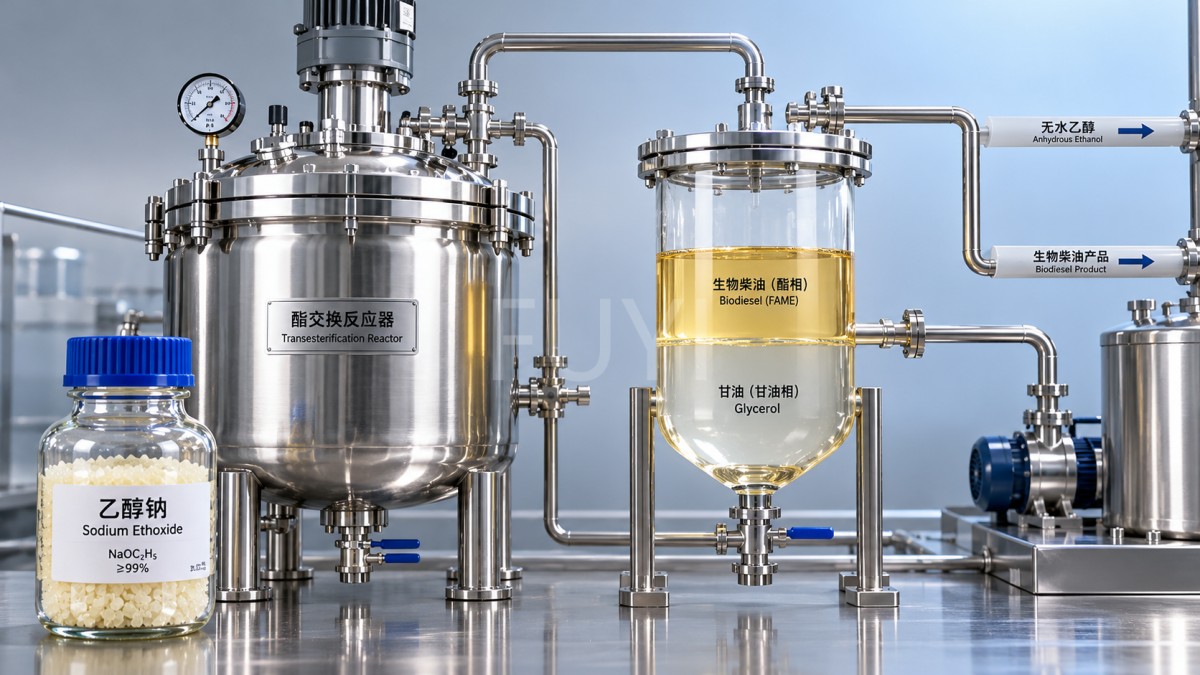
Read the catalyst specification beyond the headline percentage
For a solid-grade example, Sodium Ethoxide is listed as a yellowish powder or crystal, with total alkali of at least 99%, free alkali no more than 1.0%, and sodium carbonate no more than 0.5%. These figures provide useful purchasing criteria, but total alkali should not automatically be interpreted as an identical percentage of active ethoxide.
The analytical basis matters because different alkaline components may contribute to an assay while behaving differently in the process. Free alkali and carbonate limits help characterize the grade, but they do not replace information about moisture, active catalyst content, and consistency between batches. Catalyst dosing should use a clearly defined assay basis rather than a broad purity description.
Powder or crystals require controlled dissolution in dry ethanol before uniform dosing. A prepared ethanol solution can simplify metering, but its active concentration and solvent quality must be included in both the catalyst calculation and the alcohol balance. Comparing kilograms of solid with kilograms of solution without correcting for concentration gives a misleading cost comparison.
Packaging also affects practical suitability. The listed solid grade is available in 80 kg galvanized iron drums or customer-required packaging. Match container size to consumption and transfer arrangements: repeated opening increases exposure to moisture and carbon dioxide, which can degrade the material. Dry, closed handling and suitable storage are part of maintaining catalyst quality.
Which operating situations support the choice?
Make the decision with a trial that reflects production
A useful evaluation should include representative feedstock variation and recycled ethanol, where recycling is planned. Testing only fresh, dry materials can hide problems that emerge during routine operation. Hold the comparison basis consistent, then examine how catalyst dose, ethanol quantity, mixing, and separation conditions affect the final recovered product.
Record material losses as carefully as conversion. Catalyst purchase price is only one cost: alcohol drying, recovery energy, separation time, purification materials, and discarded ester can change the economics substantially. Laboratory separation methods should also resemble the intended plant process closely enough to support scale-up decisions.
Choose this catalyst when the process can maintain suitable feedstock quality, preserve catalyst activity during handling, and recover compliant ethyl ester without excessive losses. If those conditions are unstable, the next investment should target the limiting step—pretreatment, ethanol drying, mixing, or separation—before committing to routine catalyst supply.
Leave A Message
If you are interested in our products and want to know more details, please leave a message here, we will reply you as soon as we can.